

TL;DR: Broken links hurt your SEO by wasting crawl budget, disrupting link equity, and increasing bounce rates. The fastest free way to find them is Google Search Console’s Page Indexing report (for what Google sees) combined with Screaming Frog’s free crawl (up to 500 URLs). For larger sites, use Ahrefs or Semrush Site Audit. Once found, fix broken internal links by updating the URL, set up 301 redirects for moved pages, or remove the link entirely if no replacement exists.
I’ve been maintaining websites for years, and I can tell you from experience — broken links are one of those silent SEO killers that creep up on you. One day your site is fine, and the next you discover dozens of dead links pointing to pages that no longer exist.
According to a study by TripleChecker, 68% of websites have at least one broken link. And research from Ahrefs shows that 66.5% of all links created in the last 9 years are now dead — a phenomenon known as “link rot.” If you’re not actively monitoring your links, they’re probably decaying right now.
In this guide, I’ll walk you through exactly how I find and fix broken links on my own websites using 5 different methods — from completely free tools to premium options for larger sites. I’ll also cover how to prioritize fixes and prevent broken links from piling up again.
What Are Broken Links and Why Do They Matter?
A broken link (also called a dead link) is any hyperlink that points to a page or resource that no longer exists. When someone clicks a broken link, they get a 404 “Page Not Found” error instead of the content they expected.
Broken links happen for several common reasons:
- The destination page was deleted or moved without setting up a redirect
- The URL structure or permalink changed
- An external website you linked to went offline or restructured
- A typo in the URL when the link was originally created
- The domain name expired or was purchased by someone else
How Broken Links Hurt Your SEO
Google’s John Mueller has said that isolated 404 errors are a normal part of running a website and won’t directly tank your rankings. But when broken links pile up, the cumulative damage is real:
- Wasted crawl budget — Every time Googlebot follows a broken link and hits a 404, that’s a crawl it could have spent indexing your actual content. Google’s own documentation confirms that broken links and redirect chains waste crawl budget.
- Disrupted link equity — Internal links pass ranking power (PageRank) between your pages. A broken internal link means that equity flows into a dead end instead of strengthening another page. Fixing broken internal links has been shown to increase conversions by 8% on average.
- Higher bounce rates — Websites with broken links see a 38% higher bounce rate than those without, and 88% of users say they’re less likely to return to a site after encountering a broken link.
- Lost backlink value — If an authoritative external site links to a page on your website that returns a 404, you’re throwing away free link equity. Over time, this can reduce your domain authority by up to 17%.
The bottom line: a handful of 404s won’t destroy your rankings, but ignoring broken links over months and years will quietly erode your site’s SEO performance.
5 Methods to Find Broken Links on Your Website
I’ll cover both free and paid methods. Start with Method 1 (free) if you’re on a budget, or jump to the tool that fits your site size and needs.
Method 1: Google Search Console (Free — Best Starting Point)
Google Search Console is the first place I check because it shows you exactly what Google’s crawler has flagged. It won’t catch every broken link on your site, but it catches the ones Google cares about — which makes it the most actionable data.
Here’s how to find broken links in Google Search Console:
- Log into Google Search Console and select your property.
- Go to Pages (under “Indexing” in the left sidebar).
- Look under “Why pages aren’t indexed” and click on “Not found (404)”.
- You’ll see a list of all URLs returning 404 errors. Click on any URL to see the “Referring pages” tab — this shows which pages on your site (or external sites) are linking to that dead URL.
- After fixing a broken link, click “Validate Fix” to tell Google to re-check.
You can also check Settings → Crawl Stats → By Response to see a broader breakdown of all HTTP responses Googlebot received while crawling your site.
Limitation: GSC only reports pages that Googlebot has already attempted to crawl. It won’t catch broken links on pages Google hasn’t visited recently. That’s why I combine it with one of the crawling tools below.
Method 2: Screaming Frog SEO Spider (Free for Up to 500 URLs)
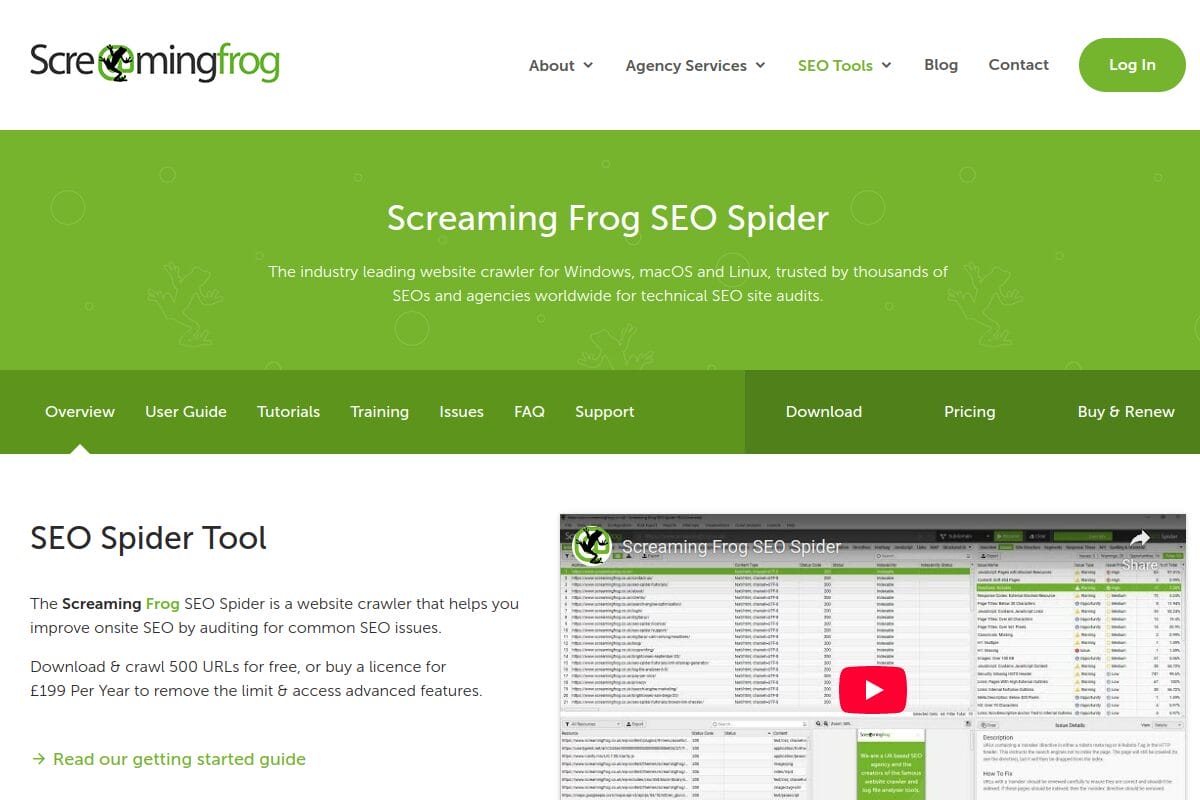
Screaming Frog is the tool I recommend for small to medium websites. The free version crawls up to 500 URLs, which is enough for most blogs and small business sites. The paid version costs $279/year and removes the URL limit.
How to find broken links with Screaming Frog:
- Download and install Screaming Frog SEO Spider (available for Windows, Mac, and Linux).
- Enter your website URL in the top bar and click Start.
- Wait for the crawl to complete (takes a few minutes for smaller sites).
- Click the “Response Codes” tab in the top panel.
- Filter by “Client Error (4xx)” using the dropdown — this shows all broken links.
- Click on any broken URL, then check the “Inlinks” tab at the bottom to see exactly which pages on your site link to it.
- To export everything, go to Bulk Export → Response Codes → Client Error (4xx) Inlinks to get a CSV with every broken link and its source page.
Screaming Frog checks internal links, external links, images, CSS files, and JavaScript resources — so it gives you the most thorough picture of any free tool. I run a Screaming Frog crawl on TheGuideX once every quarter to catch things GSC might miss.
Method 3: Dr. Link Check (Free Plan Available — Best for Cloud-Based Scanning)
Dr. Link Check is a cloud-based tool that crawls your website’s HTML and CSS code to find broken links without installing any software. What sets it apart is that it also detects malicious links and parked domain links — something most other tools don’t check for.
Key features:
- Checks internal and external broken links
- Detects malicious URLs via PhishTank integration (paid plans)
- Identifies parked domain links that could hurt your reputation
- SSL certificate checks
- Scheduled automatic scans (paid plans)
How to use Dr. Link Check:
- Go to drlinkcheck.com and sign up for the free Lite plan (checks up to 1,500 links across 2 websites).
- Click “Create Project” and enter your website URL.
- The tool will start crawling your site and analyzing every link it finds.
- Once the scan completes, the dashboard shows all links with issues — categorized by type (broken, malicious, parked, etc.).
- Click on any issue to see the source page, anchor text, and the broken URL.
- Export the results as a CSV file to fix them in batches.
Paid plans start at $13/month for 10,000 links across 5 websites and go up to $129/month for larger sites. The Lite plan is fine for smaller blogs; the Professional plan (which I used for a while) adds the PhishTank and parked domain detection that’s especially useful if you have lots of outbound links.
Method 4: Ahrefs or Semrush Site Audit (Best for Large Sites)
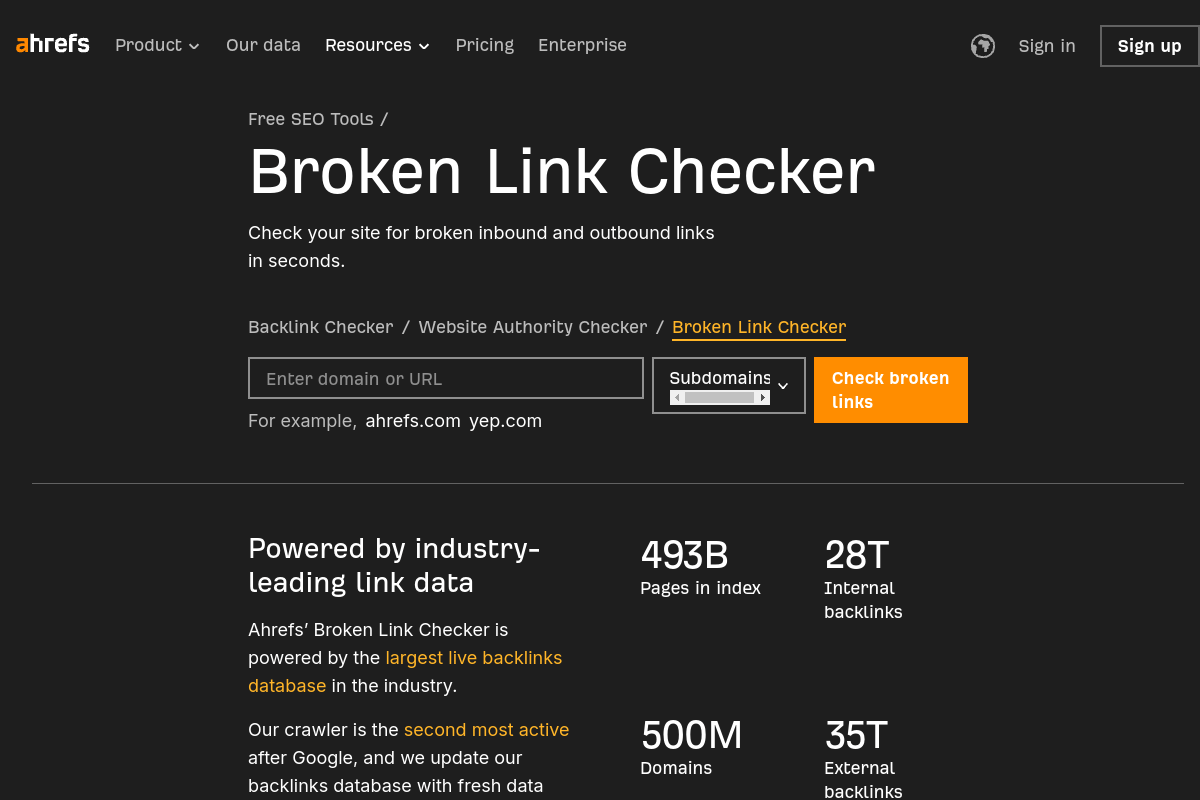
If you’re running a site with thousands of pages, you need an enterprise-grade crawler. Both Ahrefs and Semrush include site audit tools that check for broken links alongside 100+ other technical SEO issues.
Ahrefs Site Audit:
- Runs 170+ technical and on-page checks, including broken internal/external links, redirect chains, and orphan pages
- Launched an “Always-on Audit” feature in April 2025 that provides real-time continuous crawling — no more waiting for scheduled scans
- Free Webmaster Tools tier available if you verify site ownership (covers your own sites only)
- Paid plans start at $99/month (Lite)
Ahrefs also offers a free online Broken Link Checker that scans any URL for broken outbound links — no signup required.
Semrush Site Audit:
- Checks 120+ on-page and technical SEO issues including broken links, redirect chains, and orphan pages
- Includes an internal link distribution score that shows how well link equity flows across your site
- Navigate to Site Audit → Issues → “Broken internal links” and “Broken external links” for a full breakdown
- Plans start at $139.95/month (Pro, audits up to 100,000 pages/month)
Both tools are overkill if you’re just looking for broken links. But if you already subscribe to Ahrefs or Semrush for keyword research and backlink analysis, their site audit features are excellent — and you’re already paying for them.
Method 5: Broken Link Checker WordPress Plugin (Best for Ongoing Monitoring)
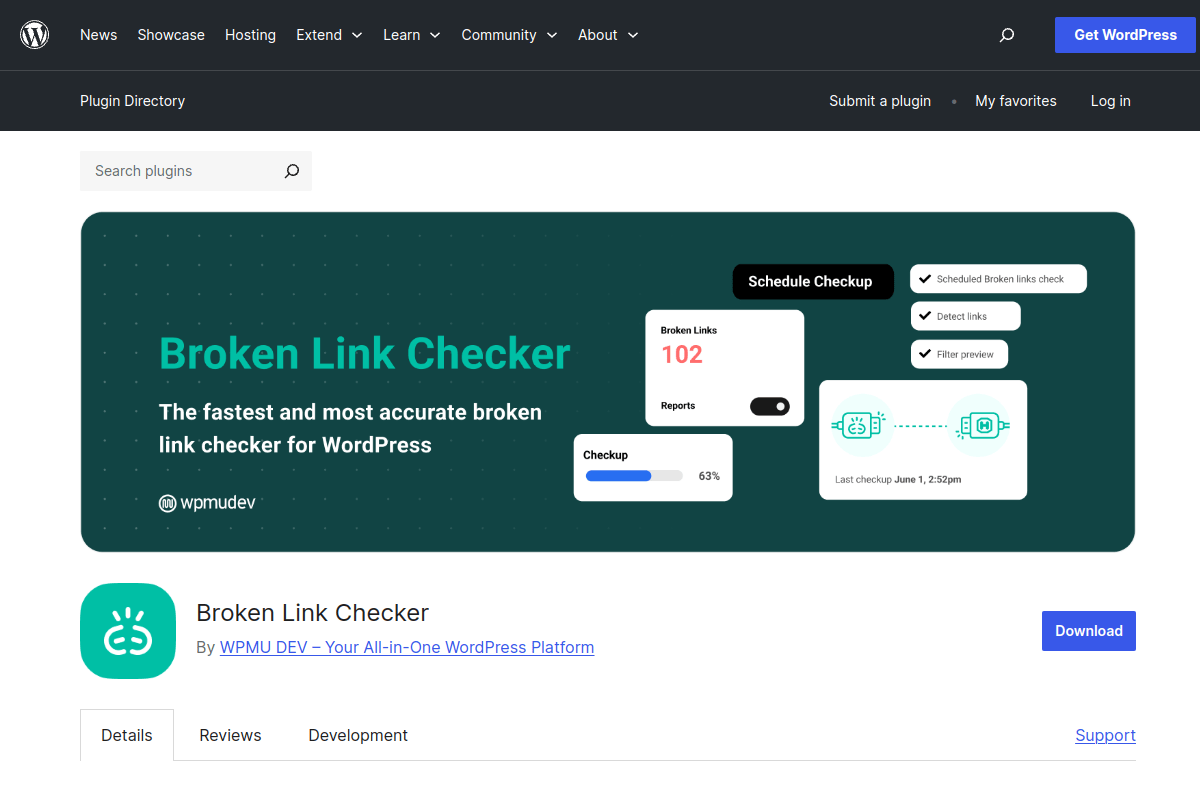
If your site runs on WordPress and you want continuous monitoring without manually running scans, the Broken Link Checker plugin is the easiest option. It has over 600,000 active installs and automatically scans your posts, pages, comments, and custom fields for broken links.
How it works:
- Install and activate the plugin from the WordPress repository (free)
- It automatically scans all your content in the background
- Sends email notifications when broken links are detected
- Lets you edit, unlink, or dismiss broken links directly from the dashboard — no need to open each post individually
Important caveat: This plugin uses server resources to run its scans. On shared hosting, it can cause slowdowns or even trigger hosting provider warnings. The cloud-based version by WPMU Dev offloads the heavy crawling to their servers, which solves this problem. If you’re on shared hosting, I’d recommend using Screaming Frog or Dr. Link Check instead and running manual scans quarterly.
Quick Comparison: Which Tool Should You Use?
| Tool | Cost | Best For | Link Limit (Free) |
|---|---|---|---|
| Google Search Console | Free | Seeing what Google flags | Unlimited (your verified sites) |
| Screaming Frog | Free / $279 per year | Thorough crawl of small-medium sites | 500 URLs |
| Dr. Link Check | Free / $13+ per month | Cloud-based scan + malware detection | 1,500 links |
| Ahrefs Site Audit | Free (own site) / $99+ per month | Large sites, real-time monitoring | Verified sites only |
| Semrush Site Audit | $139.95+ per month | Large sites, link equity analysis | No free tier |
| Broken Link Checker (WP) | Free plugin | WordPress continuous monitoring | Unlimited |
My recommendation: For most website owners, start with Google Search Console + a quarterly Screaming Frog crawl. That combination is free and covers both what Google sees and what it might miss. Add Dr. Link Check if you need the malware/phishing detection layer.
How to Fix Broken Links (The Right Way)
Finding broken links is the easy part. Fixing them correctly is what actually recovers your SEO value. Here’s how to handle each type:
Fix 1: Update the Link (Best for Broken Internal Links)
If a page on your own site moved to a new URL, simply update the link to point to the correct URL. This is the cleanest fix because it removes the broken link entirely — no redirect needed.
For example, if your blog post links to /old-page-slug/ and the page now lives at /new-page-slug/, go into the post editor and change the href directly.
Fix 2: Set Up a 301 Redirect (Best for Moved Pages with Backlinks)
If the broken URL has backlinks pointing to it from external sites, a 301 redirect transfers the SEO value from the old URL to the new one. This is especially important for pages that rank or have been linked to by authoritative sites.
The critical rule: Only redirect to relevant replacement content. Google treats irrelevant 301 redirects as soft 404s, which means you get zero SEO benefit. Redirecting your deleted blog post about “WordPress plugins” to your homepage just because it exists is a waste.
In WordPress, you can set up redirects using plugins like Rank Math (which has a built-in redirect manager) or the free Redirection plugin.
Fix 3: Remove the Link (When No Replacement Exists)
If an external site you linked to has gone offline and there’s no suitable replacement, the best option is to simply remove the link. Keep the surrounding text if it still makes sense, but unlink the dead URL.
Fix 4: Return a 410 (Gone) for Permanently Deleted Pages
If you’ve deliberately deleted a page and there’s no replacement, returning a 410 (Gone) status code instead of a 404 tells Google the page was intentionally removed. Google processes 410s faster than 404s when de-indexing pages, which helps keep your index clean.
How to Prioritize Which Broken Links to Fix First
If you’ve run a scan and found dozens (or hundreds) of broken links, don’t try to fix them all at once. Prioritize in this order:
- Broken internal links on high-traffic pages — These are directly hurting your best-performing content. Fix them first.
- Broken links with backlinks from authoritative sites — You’re losing free link equity. Set up 301 redirects to reclaim it.
- Broken links on conversion pages — Product pages, landing pages, contact pages. Broken links here directly cost you money.
- Broken external links — These hurt user experience but are lower priority than internal link issues. Fix them in batches.
How to Prevent Broken Links From Piling Up
Finding and fixing broken links is a one-time effort. Keeping them from coming back requires a system:
- Set a quarterly scan schedule — I run a Screaming Frog crawl every 3 months. Mark it on your calendar.
- Always set up redirects when changing URLs — Whenever you change a post slug, delete a page, or restructure your site, create a 301 redirect from the old URL to the new one before making the change.
- Check external links when updating old content — Pew Research found that 38% of web pages from 2013 had disappeared by 2023. Every time you refresh an old article, verify that all outbound links still work.
- Use a monitoring tool for real-time alerts — Ahrefs’ Always-on Audit (launched April 2025) provides continuous crawling. For WordPress sites, the Broken Link Checker plugin sends email alerts when links break.
- Link to stable, authoritative sources — When adding external links, prefer well-established sites (official documentation, Wikipedia, major publications) over small blogs that might disappear.
Frequently Asked Questions
Do broken links directly hurt Google rankings?
Isolated 404 errors won’t directly tank your rankings — Google’s John Mueller has confirmed this. However, accumulated broken links waste crawl budget, break internal link equity flow, and increase bounce rates, all of which indirectly hurt your SEO performance over time.
How often should I check for broken links?
Monthly for active sites that publish frequently. Quarterly for smaller sites with less content turnover. At minimum, check every time you do a major content update or site restructuring.
What is the difference between a 404 and a 410 status code?
A 404 means “not found” — the page might come back someday. A 410 means “gone” — the page was intentionally deleted and won’t return. Google processes 410s faster when removing pages from its index, so use 410 for pages you’ve deliberately removed.
Should I redirect all 404 pages to my homepage?
No. Google treats irrelevant redirects as soft 404s anyway, so redirecting everything to your homepage provides zero SEO benefit. Only redirect to a closely related, relevant page. If no relevant replacement exists, let the 404 stand or return a 410.
What is link rot?
Link rot is the gradual decay of hyperlinks over time as web pages move, get deleted, or go offline. Ahrefs found that 66.5% of links from the last 9 years are now dead, and a Harvard study of New York Times articles showed 25% of linked pages were inaccessible — with decay growing sharply over time.
Is the Broken Link Checker WordPress plugin safe to use?
Yes, it’s actively maintained with over 600,000 installs. The main concern is server resource usage — it can slow down sites on shared hosting. If that’s you, use the cloud-based WPMU Dev version or stick to manual quarterly scans with Screaming Frog or Dr. Link Check instead.
Can I use broken link building for SEO?
Yes — broken link building is a legitimate white-hat link building strategy. You find dead links on other websites, create replacement content, and pitch the site owner with a helpful outreach email. It works because you’re solving a problem for them while earning a backlink.
Summing Up!
Broken links are inevitable — with 66.5% of links decaying within 9 years, every website accumulates them over time. The key is catching and fixing them before they pile up enough to hurt your SEO and user experience.
Start with Google Search Console to see what Google has already flagged, then run a Screaming Frog crawl for a more thorough check. If you need ongoing monitoring, use Dr. Link Check or the Broken Link Checker plugin for WordPress. And for large sites, Ahrefs or Semrush Site Audit give you the most comprehensive coverage.
Have a question about finding or fixing broken links on your site? Drop it in the comments — I’m happy to help troubleshoot!



