

I’ve spent the last few weeks testing and evaluating vulnerability scanners, and the landscape has shifted dramatically. With 48,185 new CVEs published in 2025 — roughly 133 per day — and the average time-to-exploit dropping from 32 days to just 5 days (VulnCheck), picking the right scanner isn’t optional anymore. It’s survival.
Intruder.io is a decent platform for lean security teams. But after their recent price increases and some frustrating limitations, I started looking for alternatives. I’ve done similar deep-dive comparisons for SEO tools before, and I’m bringing the same approach here — real pricing, honest pros and cons, no fluff.
This guide covers 12 Intruder alternatives across every category: enterprise platforms, mid-market scanners, developer-first tools, open-source options, and cloud-native security. Let’s find the right fit for your team.
TL;DR: The best Intruder alternative depends on your situation. For enterprise vulnerability management, go with Qualys VMDR or Tenable Nessus. Budget-conscious SMBs should try HostedScan ($29/month). Developers need Snyk for DevSecOps integration. Cloud-native teams should look at Wiz. And if you want a free option, Nuclei (open source) with 11,000+ templates is excellent.
Quick Comparison: All 12 Intruder Alternatives
Here’s a side-by-side overview before we dive into each tool. As of March 2026, these are the current pricing tiers:
| Tool | Starting Price | Best For | Type |
|---|---|---|---|
| Qualys VMDR | ~$596/mo | Large enterprises | Network + Cloud |
| Tenable Nessus | Free / $4,390/yr | Scan accuracy | Network |
| Rapid7 InsightVM | $1.93/asset/mo | Remediation workflows | Network + Cloud |
| Invicti | ~$6,000+/yr | Web app security | DAST + SAST |
| Acunetix | ~$1,995/yr | Mid-size AppSec | DAST |
| Pentera | $35,000+/yr | Automated pentesting | BAS |
| HostedScan | $29/mo | Budget SMBs | Network + Web |
| Snyk | Free / $25/dev/mo | Developer security | SCA + SAST + DAST |
| Detectify | ~$275/mo | Attack surface discovery | EASM |
| Nuclei | Free (open source) | Security researchers | Customizable |
| Wiz | ~$38,000+/yr | Cloud-native security | CNAPP |
| Astra Pentest | $199/mo | Compliance certification | Pentest + DAST |
What Is Intruder.io?
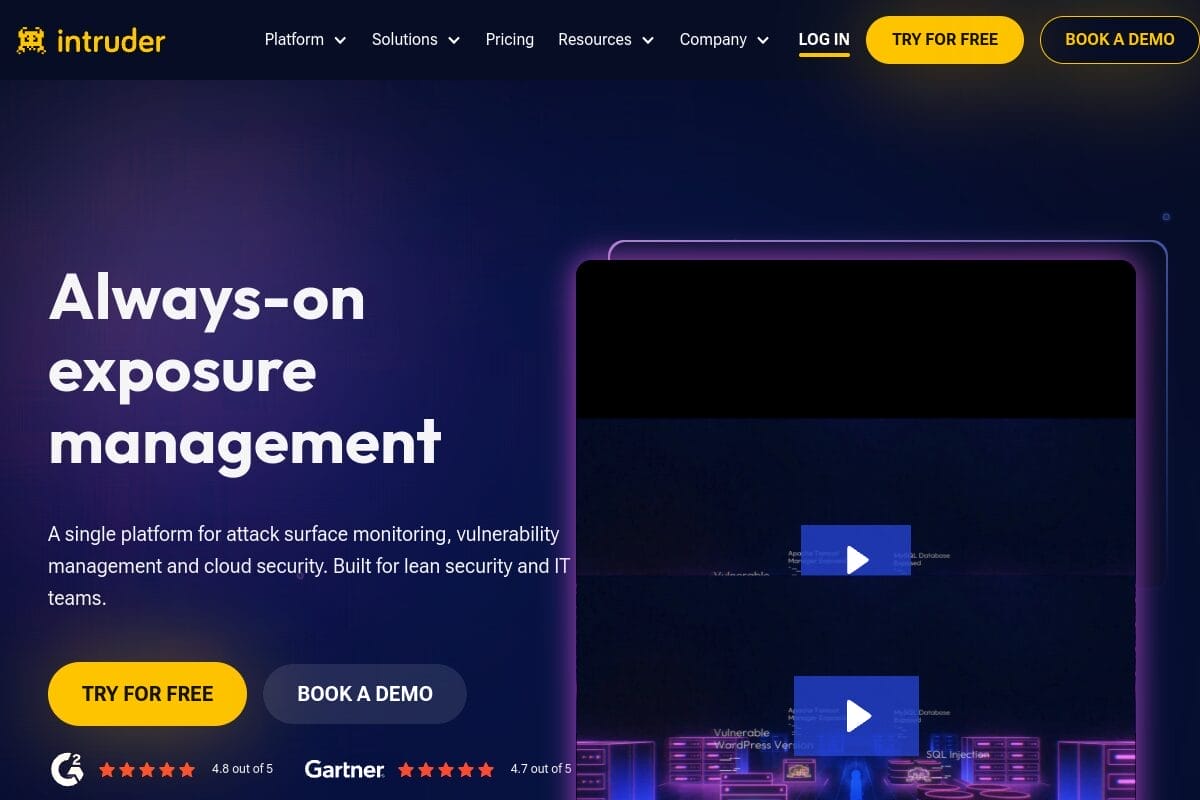
Intruder is a cloud-based vulnerability management platform founded in 2015 in London by Chris Wallis, a former ethical hacker who worked on critical national infrastructure. It’s built for lean security teams and SMBs who need continuous vulnerability scanning without enterprise complexity.
As of March 2026, Intruder has a 4.8/5 rating on G2 (200+ reviews), serves over 3,000 companies worldwide, and was named to G2’s 2026 Best UK Software list. The platform scans infrastructure, web applications, and cloud environments — then uses smart noise reduction to surface what actually matters.
Intruder Pricing in 2026
| Plan | Starting Price | Scan Frequency | Key Limitations |
|---|---|---|---|
| Essential | $149/month | Monthly | No integrations, 1 scheduled scan |
| Pro | $499/month | Weekly | Internal scanning starts here |
| Premium | Custom | Daily | Full feature set |
Intruder offers a 14-day free trial with Cloud plan features (5 free licenses, 5 targets). Pricing is license-based — separate licenses for infrastructure targets and web application scanning targets.
Why Are People Looking for Intruder Alternatives?
Let me be clear — Intruder is a good product. But it has limitations that push certain users to look elsewhere. Here’s what I’ve found after digging through reviews and talking to security teams:
- Pricing has jumped significantly — Intruder quietly increased prices and removed their pricing calculator. The $149/month Essential plan only gives you monthly scans with zero integrations.
- Internal scanning requires the $499/month Pro plan — that’s a steep jump from Essential just to scan internal assets.
- No SAST, SCA, or container scanning — Intruder is purely external and network focused. If you need to scan code, dependencies, or containers, you’ll need another tool anyway.
- False positives from underlying engines — Intruder uses OpenVAS and OWASP ZAP under the hood, which means you inherit their false positive rates.
- No AI-driven testing — it struggles with modern single-page applications and complex API authentication flows.
- Slow scan times during peak hours — multiple users report delays when shared cloud infrastructure is under heavy load.
None of these are dealbreakers for everyone. But if you need deeper scanning, better pricing, DevSecOps integration, or cloud-native capabilities — the alternatives below deserve your attention.
12 Best Intruder Alternatives in 2026
1. Qualys VMDR — Best for Large Enterprises
Qualys VMDR is the enterprise gold standard for vulnerability management. It combines asset discovery, vulnerability assessment, threat prioritization, and patch management into a single cloud platform with a 99.99% uptime SLA.
Pricing: Starts at approximately $596/month. Web Application Scanning (WAS) runs $1,995/year per 25 web apps. Custom enterprise pricing available.
- TruRisk scoring that prioritizes vulnerabilities by actual business impact
- Built-in patch management — scan, prioritize, and patch in one workflow
- AWS, Azure, and GCP cloud connectors with pre-approved scanning
- FedRAMP authorized for government compliance requirements
- Largest vulnerability signature database in the industry
Best for: Enterprises with 1,000+ assets, regulated industries (healthcare, finance, government), and organizations that need vulnerability + patch management in a single platform.
My take: Qualys is overkill for SMBs, but if you’re managing thousands of assets across hybrid environments, nothing else matches its maturity and compliance alignment.
2. Tenable Nessus — Best for Scan Accuracy & Coverage
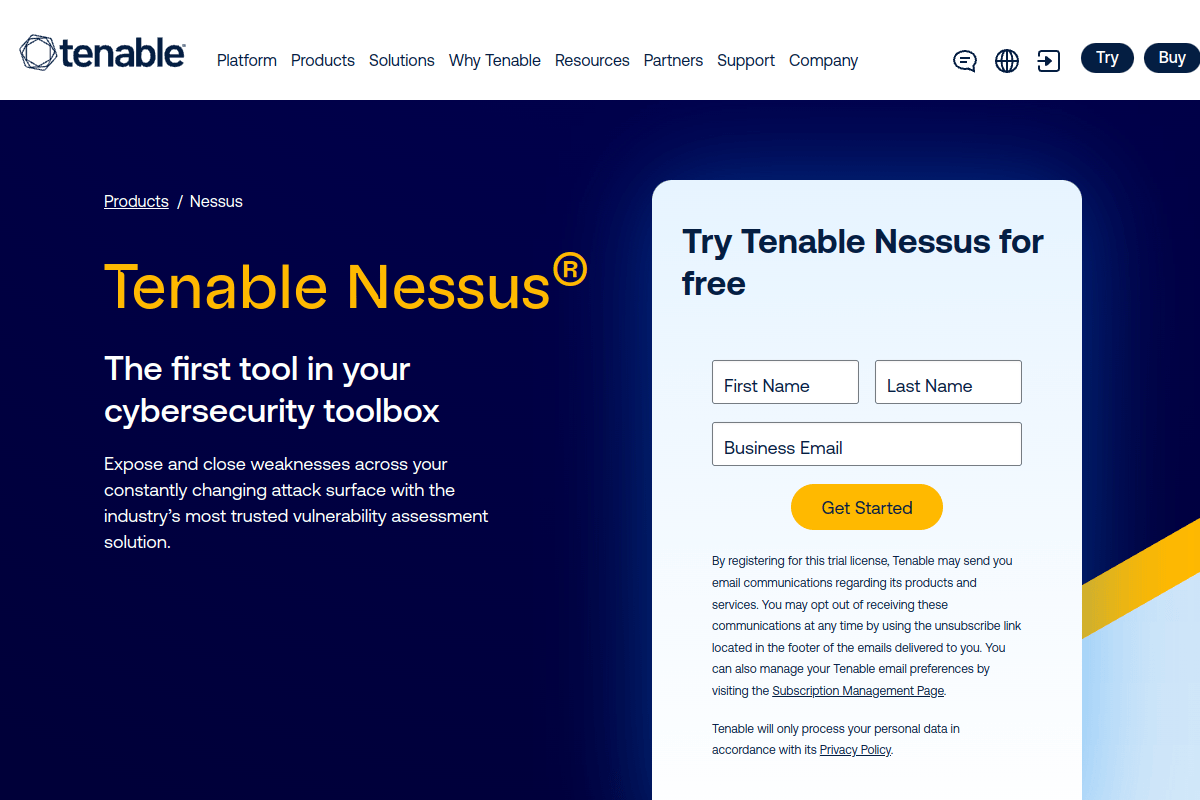
Tenable Nessus is the most widely deployed vulnerability scanner in the world, running over 200,000 vulnerability checks with the industry’s lowest false positive rate. If accuracy is your top priority, Nessus is hard to beat.
Pricing (updated March 2026 — prices increased):
- Nessus Essentials: Free (up to 16 IPs — great for home labs)
- Nessus Professional: $4,390/year
- Nessus Expert: $6,390/year (includes external attack surface and IaC scanning)
- 200,000+ vulnerability checks with 500+ prebuilt scan policies
- Industry-lowest false positive rate
- Configuration and compliance auditing out of the box
- Agent-based and agentless scanning options
- Massive community with detailed documentation
Best for: Security teams that need deep, accurate assessments. Pentesters, consultants, and organizations of all sizes. The free tier (16 IPs) is genuinely useful for small setups.
My take: Nessus is the scanner every security professional learns on. The free tier is a real product (not a marketing gimmick), and the paid version is the gold standard in vulnerability detection. Prices went up in March 2026, though.
3. Rapid7 InsightVM — Best for Remediation Workflows
Rapid7 InsightVM goes beyond finding vulnerabilities — it connects scanning to remediation workflows through Jira, ServiceNow, and built-in project tracking. If your team is great at scanning but terrible at actually fixing what they find, InsightVM closes that gap.
Pricing: $1.93/asset/month (~$23.18/asset/year). Minimum 512 assets required, annual billing only. Entry-level starts around $11,900/year.
- Active Risk scoring enriched with real-world threat intelligence
- Automated remediation projects with Jira and ServiceNow ticket integration
- Live dashboards for tracking risk reduction over time
- Container and cloud asset scanning included
- Plugs into Rapid7’s broader detection and response (XDR) ecosystem
Best for: Mid-to-large organizations using Jira or ServiceNow that want vulnerability scanning tightly coupled with remediation tracking and detection/response.
My take: Most vulnerability scanners are great at finding problems but terrible at helping you fix them. Rapid7 InsightVM is the exception. The 512-asset minimum makes it impractical for small teams, though.
4. Invicti — Best for Web App Security (Near-Zero False Positives)
Invicti (formerly Netsparker) is an enterprise DAST platform with a killer feature: Proof-Based Scanning. Instead of just flagging potential issues, it automatically confirms vulnerabilities — delivering 99.98% detection accuracy with near-zero false positives.
Pricing: Custom (previously started around $6,000-$9,000/year). Available on AWS Marketplace. Contact sales for current quotes.
- Proof-Based Scanning that confirms vulnerabilities automatically
- Unified DAST + SAST + SCA in one platform
- Scans REST, SOAP, and GraphQL APIs at the same depth as web apps
- AI-powered predictive risk scoring
- Full CI/CD integration for DevSecOps workflows
Best for: Organizations with complex web applications and APIs that are tired of triaging false positives. AppSec teams consolidating multiple security tools into one platform.
My take: If your team spends hours every week triaging false positives, Invicti’s proof-based approach will save your sanity. The enterprise-only pricing puts it out of reach for smaller shops, though.
5. Acunetix — Best for Mid-Size AppSec Teams
Acunetix (by Invicti) detects 7,000+ vulnerability types including XSS, SQL injection, SSRF, and OWASP Top 10 issues. It’s essentially Invicti’s more accessible sibling — strong web application scanning without the enterprise price tag. Whether you’re securing a WordPress website or a complex enterprise web app, Acunetix handles both.
Pricing: Starts at approximately $1,995/year for the basic tier. Full plans run around $7,000/year on AWS Marketplace. Minimum 5 targets with a 2-year subscription.
- DeepScan technology handles AJAX-heavy single-page applications
- AcuSensor combines black-box scanning with source code feedback (IAST capability)
- CI/CD integration with Jenkins, GitLab CI, and Azure DevOps
- Combined network and web application scanning
- REST API for full automation
Best for: Small to mid-sized teams starting their application security program who need reliable web scanning at a more accessible price than Invicti or Qualys.
My take: Acunetix hits the sweet spot between capability and cost for web application scanning. The 2-year subscription commitment is annoying, but the scanning quality justifies it.
6. Pentera — Best for Automated Penetration Testing
Pentera isn’t just a vulnerability scanner — it’s an automated penetration testing platform. It doesn’t just find vulnerabilities; it actually exploits them safely to prove whether your defenses work. Think of it as a red team member that runs 24/7.
Pricing: Starts at $35,000+/year. Custom quotes based on organizational scope.
- Full attack simulation: lateral movement, privilege escalation, data exfiltration
- Three modules: Pentera Core (internal), Surface (external), Cloud
- Maps findings directly to the MITRE ATT&CK framework
- Continuous security validation, not just point-in-time scanning
- Board-ready reporting that executives can actually understand
Best for: Organizations that need to validate their defenses beyond scanning. Red team augmentation. Companies preparing for compliance audits or security assessments.
My take: Pentera answers a different question than scanners do. Instead of “do we have vulnerabilities?” it answers “could an attacker actually exploit them?” That distinction is massive. The $35K+ price tag limits it to mature security programs, though.
7. HostedScan — Best Budget-Friendly Alternative
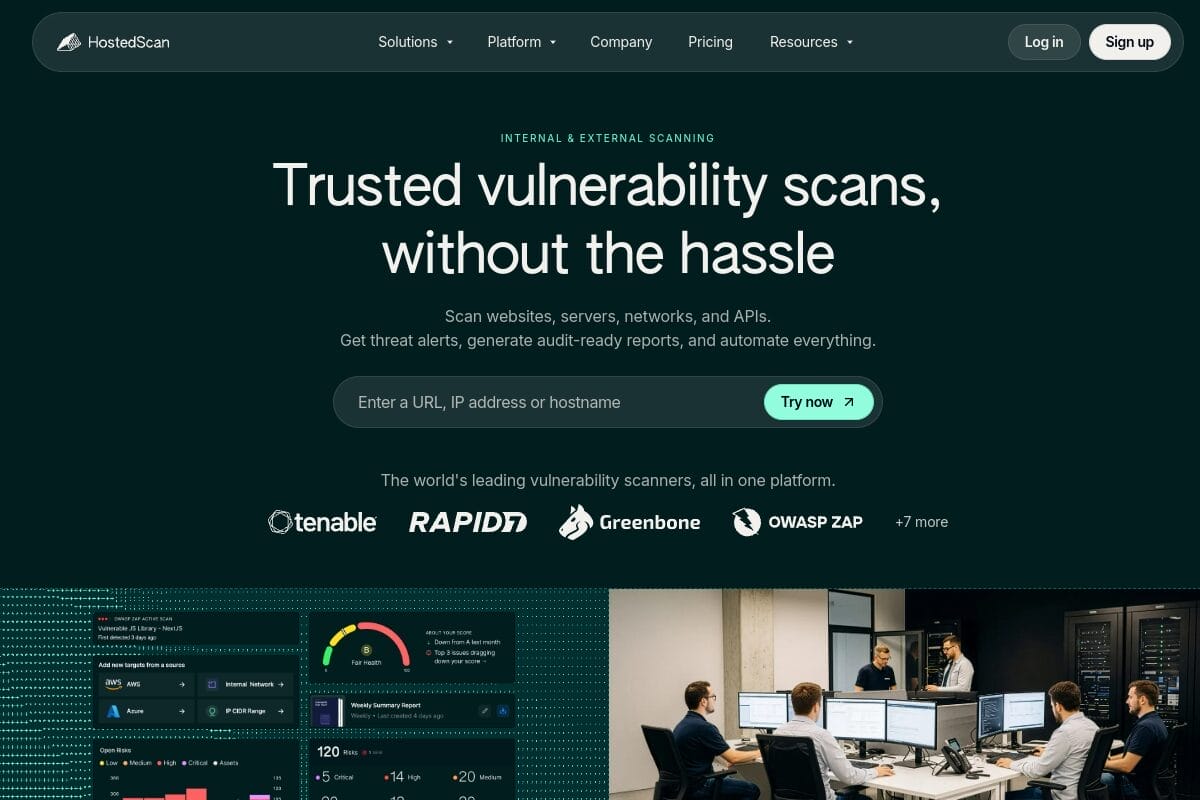
HostedScan packages open-source scanning engines (Nmap, OpenVAS, OWASP ZAP, SSLyze) into a managed cloud platform starting at just $29/month. If Intruder’s pricing is pushing you away but you want the same type of scanning, HostedScan delivers similar results at a fraction of the cost.
Pricing: Free tier available. Paid plans start at $29/month with 5 targets included. 30-day money-back guarantee.
- Automated scheduled scans across websites, servers, networks, and APIs
- White-label reporting for MSPs and MSSPs
- Compliance-aligned reports (PCI DSS, HIPAA, GDPR, ISO 27001)
- Integrations with Jira, Slack, SIEM platforms, and webhooks
- PDF and CSV export for audit documentation
Best for: SMBs and startups on a tight security budget. MSPs and MSSPs needing white-label scanning. Teams that want managed open-source scanning without maintaining infrastructure.
My take: HostedScan is the closest direct Intruder alternative at roughly 5x lower cost. It uses the same underlying engines (OpenVAS, ZAP), so scanning quality is comparable. The tradeoff is less sophisticated prioritization and fewer advanced features.
8. Snyk — Best for Developer-First Security
Snyk is the leading developer security platform, covering open-source dependencies (SCA), custom code (SAST), containers, and infrastructure-as-code. After acquiring Probely in November 2024, Snyk now offers DAST and API security testing too — making it a full-lifecycle alternative to Intruder.
Pricing: Free tier available (generous for individual developers). Team plan: $25/developer/month (5-10 developers). Enterprise: custom pricing.
- Snyk Open Source (SCA), Code (SAST), Container, and IaC scanning
- New: Snyk API & Web (via Probely acquisition) for DAST and API testing
- “Reachability” analysis filters noise by identifying truly exploitable paths
- IDE plugins and PR checks — security feedback right where developers work
- Massive vulnerability database with actionable fix guidance
Best for: Development teams adopting DevSecOps. Organizations building API-heavy or cloud-native apps. Companies that want security integrated into their CI/CD pipeline, not bolted on after deployment.
My take: Snyk is the tool I’d pick if I were building a security program from scratch for a modern dev team. The free tier is genuinely generous, and the Probely acquisition plugs its biggest gap (DAST). At $25/dev/month the cost scales fast with large teams, though.
9. Detectify — Best for External Attack Surface Management
Detectify is powered by a community of 400+ ethical hackers who contribute real-world vulnerability research. This gives it a significant edge over purely automated scanners — it catches zero-days and novel attack vectors that CVE-based tools miss entirely.
Pricing: Surface Monitoring starts at ~$275/month (up to 25 subdomains, annual billing). Application Scanning: ~$82/month per scan profile. Enterprise: custom.
- Crowdsourced vulnerability research from 400+ ethical hackers
- AI researcher “Alfred” for continuous detection updates
- Automatic asset discovery across AWS, Azure, GCP, Cloudflare, and DigitalOcean
- Zero-day detection faster than CVE-based scanners
- Attack surface monitoring with continuous asset discovery
Best for: Companies with large, sprawling external attack surfaces. Multi-cloud environments. Organizations that want detection of novel threats beyond standard CVE databases.
My take: The crowdsourced hacker community is Detectify’s superpower. Automated scanners can only find what they’re programmed to look for — these researchers find things nobody’s catalogued yet. Purely external-only, though, so pair it with an internal scanner.
10. Nuclei — Best Free & Open-Source Scanner
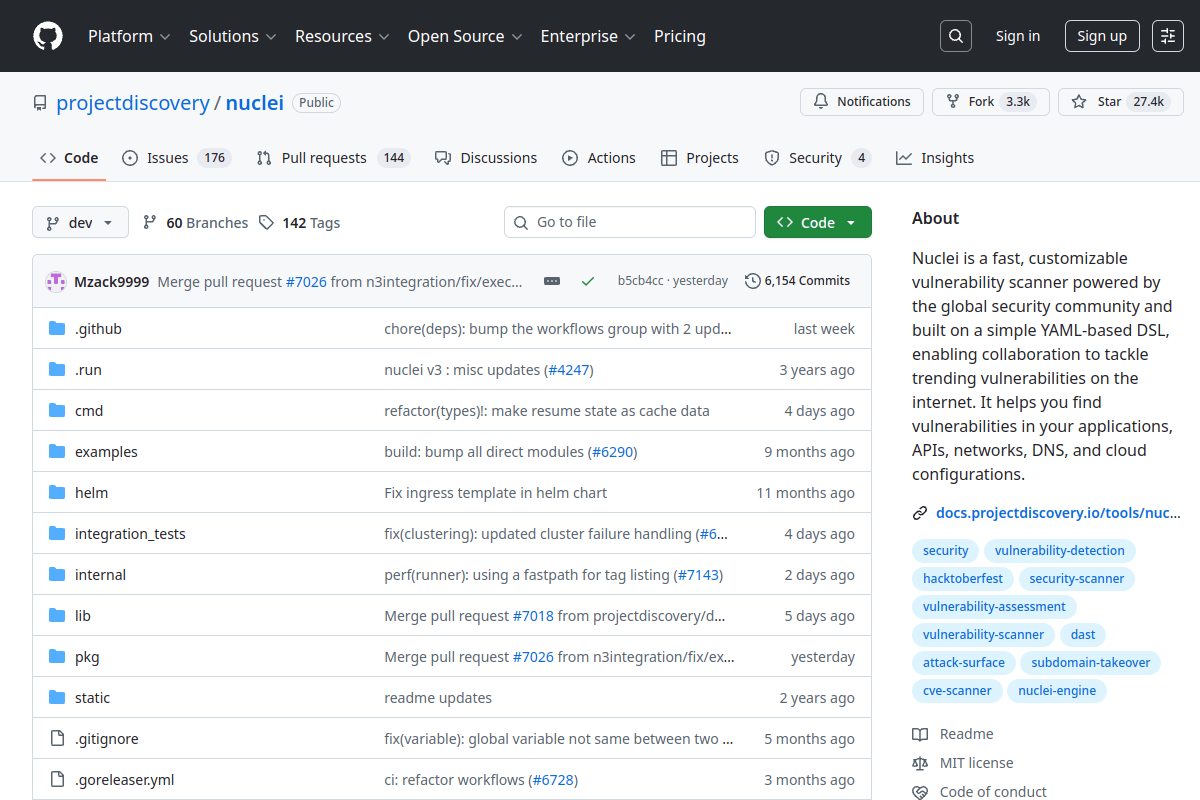
Nuclei by ProjectDiscovery is the most popular open-source vulnerability scanner with 11,000+ community-maintained templates covering CVEs, misconfigurations, exposed panels, default credentials, and more. Completely free and blazing fast.
Pricing: Free and open source. ProjectDiscovery also offers a paid cloud platform (PDCP) for teams wanting managed scanning with a GUI.
- 11,000+ YAML templates for fully customizable vulnerability detection
- Supports HTTP, TCP, DNS, SSL, WHOIS, and JavaScript protocols
- AI-powered template generation from natural language descriptions
- Ultra-fast parallel processing for large-scale scanning
- Integrations with Jira, Splunk, GitHub, Elastic, and GitLab
Best for: Security researchers, pentesters, bug bounty hunters, and DevSecOps teams comfortable with CLI tools. Anyone who wants powerful vulnerability scanning without paying a dime.
My take: Nuclei proves you don’t need an expensive subscription to find real vulnerabilities. The catch? It requires technical expertise — there’s no pretty dashboard or point-and-click interface. Pure command line. If that doesn’t scare you, it’s incredibly powerful.
11. Wiz — Best for Cloud-Native Security
Wiz is the leading Cloud-Native Application Protection Platform (CNAPP), combining cloud security posture management, workload protection, vulnerability scanning, and more into a single agentless platform. Big news: Google is acquiring Wiz for $32 billion — the largest cybersecurity acquisition ever (EU approved February 2026, expected to close by end of March 2026).
Pricing: Enterprise only. Wiz Advanced starts at approximately $38,000/year. Custom pricing based on cloud workload volume.
- Agentless scanning across AWS, Azure, and GCP — deploys in minutes
- Graph-based security model that maps actual attack paths, not just individual findings
- CSPM, CWPP, CIEM, DSPM, Kubernetes security, and CDR in one platform
- Vulnerability management with blast-radius-aware risk prioritization
- Infrastructure-as-code security and container image scanning
Best for: Cloud-first organizations running on AWS, Azure, or GCP. Enterprises that need a single pane of glass for cloud security posture and vulnerability management.
My take: Wiz is the most impressive security platform I’ve seen in recent years. Its graph model doesn’t just show vulnerabilities — it maps whether they’re actually exploitable and what the blast radius would be. The Google acquisition creates uncertainty about multi-cloud neutrality, but for now, it’s best-in-class.
12. Astra Pentest — Best for Compliance Certification
Astra Pentest combines automated scanning (9,300+ tests) with manual pentesting by security experts, and provides a publicly verifiable pentest certificate upon completion — which is gold for compliance requirements like SOC 2, ISO 27001, and HIPAA.
Pricing: Scanner plan at $199/month ($1,999/year per target). Pentest plan at $5,999/year with expert testing. Enterprise at $9,999/year.
- 9,300+ automated vulnerability tests across web, mobile, API, and cloud
- Manual pentesting by certified security experts (Pentest and Enterprise plans)
- Publicly verifiable pentest certificate for compliance audits
- CI/CD integration for continuous automated scanning
- Interactive dashboard for vulnerability collaboration between teams
Best for: Organizations that need a formal pentest certificate for compliance audits. Companies wanting a blend of automated scanning and human pentesting expertise.
My take: The publicly verifiable pentest certificate is Astra’s true differentiator. If you’re going through a SOC 2 audit or your clients require proof of security testing, this is one of the most practical options. The scanner-only plan at $199/month is competitive for standalone DAST too.
Which Vulnerability Scanner Should You Actually Pick?
With 12 options on the table, here’s a decision framework to make this simple:
| If You Are… | Go With | Why |
|---|---|---|
| Enterprise with 1,000+ assets | Qualys VMDR | Most mature platform with compliance alignment |
| Prioritizing scan accuracy | Tenable Nessus | Lowest false positive rate, 200K+ checks |
| Struggling with remediation | Rapid7 InsightVM | Best remediation workflows, Jira/ServiceNow integration |
| AppSec team with complex APIs | Invicti | Proof-based scanning, near-zero false positives |
| Mid-size team starting AppSec | Acunetix | Strong web scanning at accessible pricing |
| Validating actual defenses | Pentera | Goes beyond scanning to real exploitation testing |
| SMB on a tight budget | HostedScan | Same engines as Intruder at 5x lower cost |
| Dev team doing DevSecOps | Snyk | IDE integration, PR checks, full SDLC coverage |
| Large external attack surface | Detectify | 400+ ethical hackers finding zero-days |
| Technical user wanting free tools | Nuclei | 11K+ templates, completely free and open source |
| Cloud-first (AWS/Azure/GCP) | Wiz | Best-in-class CNAPP with agentless deployment |
| Need pentest certification | Astra Pentest | Compliance-ready with verifiable certificate |
Here’s a tip from experience: don’t try to pick one tool that does everything. The cybersecurity market is increasingly specialized in 2026, and many organizations run 2-3 complementary tools. For example, Nessus for infrastructure + Snyk for code + Detectify for external attack surface is a powerful combination.
The vulnerability scanning market hit $1.5 billion in 2026 and is projected to reach $3.8 billion by 2033 — a 10.5% CAGR. Meanwhile, the average data breach costs $4.44 million globally and $10.22 million in the US (IBM 2025 Cost of a Data Breach Report). The math is clear: the cost of a good scanner is a rounding error compared to the cost of not having one.
Frequently Asked Questions
Is Intruder a good vulnerability scanner?
Yes, Intruder is solid for small to mid-sized teams needing easy cloud vulnerability scanning. It scores 4.8/5 on G2 with 200+ reviews. However, pricing has increased, and it lacks SAST, container scanning, and advanced API testing — which pushes some users toward alternatives like Snyk or Tenable Nessus.
What is the best free vulnerability scanner in 2026?
Nuclei (open source) is the best free vulnerability scanner with 11,000+ community templates. For infrastructure scanning, Nessus Essentials is free for up to 16 IPs. Snyk also offers a generous free tier for code and dependency scanning.
How much does Intruder cost in 2026?
Intruder’s Essential plan starts at $149/month (monthly scans only). The Pro plan costs $499/month with weekly scans and internal scanning capability. Premium plans have custom pricing. A 14-day free trial is available with 5 targets.
What scanning engines does Intruder use under the hood?
Intruder uses OpenVAS and OWASP ZAP as its underlying scanning engines, enhanced with proprietary checks and noise reduction. This means it inherits the detection capabilities — and some false positive rates — of these open-source tools.
How often should you run vulnerability scans?
For external assets, scan at least weekly. For critical infrastructure, daily or continuous scanning is recommended. With 48,185 CVEs published in 2025 and the average time-to-exploit at just 5 days, monthly-only scanning leaves dangerous gaps between assessments.
Is Nessus better than Intruder?
They serve different needs. Nessus offers deeper, more accurate scanning with 200,000+ checks and the lowest false positive rate — but requires more technical expertise. Intruder is simpler with better noise reduction and cloud integrations. Pick Nessus for accuracy, Intruder for ease of use.
Summing Up!
The vulnerability scanning market changed dramatically in 2025-2026. With the shift toward proactive security, tools are getting more specialized, M&A is reshaping the landscape (Google acquiring Wiz for $32B, Snyk acquiring Probely), and threat velocity keeps accelerating — 48,185 CVEs in 2025 with the average exploit window shrinking to just 5 days.
Intruder remains a solid scanner for lean teams that want simplicity. But if you need more depth, better pricing, or capabilities it doesn’t offer, the 12 alternatives above have you covered. My personal picks: Tenable Nessus for pure scanning accuracy, HostedScan for budget-conscious teams, Snyk for DevSecOps workflows, and Wiz for cloud-native environments.
Start with the decision table above, narrow it down to 2-3 options, and take advantage of free trials. The worst thing you can do in 2026 is not scan at all — because attackers are definitely scanning you.



