

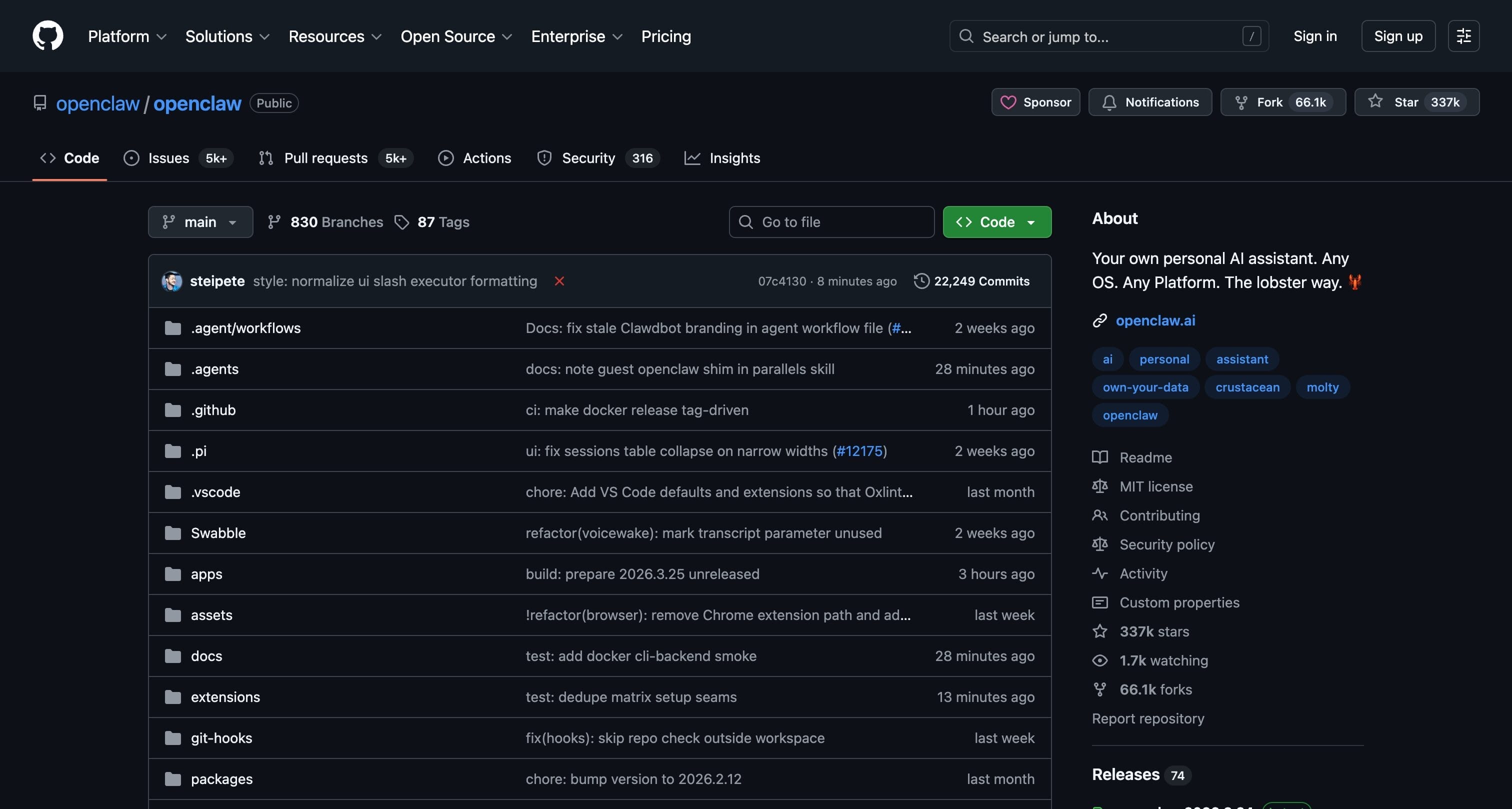
TL;DR: OpenClaw is the most-starred project on GitHub (337K+ stars) — a self-hosted AI personal assistant that connects to WhatsApp, Telegram, Slack, and 20+ messaging platforms. But it’s a massive TypeScript codebase with security concerns and complex setup. Here are 19 alternatives that might be a better fit — from lightweight Python agents like grip-ai to enterprise platforms like Dify and Manus AI.
OpenClaw exploded onto the scene in late 2025 (originally as “Clawdbot”), became the fastest project to reach 100K GitHub stars, and now sits at 337K+ stars — surpassing React’s decade-long record in just 60 days.
But popularity doesn’t mean it’s perfect for everyone.
OpenClaw requires TypeScript knowledge to customize, demands broad system permissions (email, calendars, messaging), had a serious RCE vulnerability disclosed (CVE-2026-25253), and the codebase is massive. If you want something simpler, more secure, Python-based, or better suited to your specific use case — this list is for you.
I’ve tested or reviewed all 19 alternatives below. Each one solves a different problem. Let’s find yours.
What Is OpenClaw? (Quick Overview)
OpenClaw is an open-source, self-hosted AI personal assistant created by Peter Steinberger (founder of PSPDFKit, now at OpenAI). It uses LLMs as its brain and messaging platforms as its interface.
| Detail | OpenClaw |
|---|---|
| GitHub Stars | 337,000+ (most-starred project on GitHub) |
| Language | TypeScript |
| License | MIT |
| Messaging Channels | 25+ (WhatsApp, Telegram, Slack, Discord, Signal, iMessage, Teams) |
| LLM Support | Claude, ChatGPT, Gemini, DeepSeek, Grok, Ollama, and more |
| Skills/Plugins | 5,400+ on ClawHub registry |
| Pricing | Free (you pay for LLM API usage, ~$5-30/month) |
| Sponsors | OpenAI, Vercel, Blacksmith, Convex |
Why look for alternatives? Complex TypeScript codebase, broad permission requirements, RCE vulnerability (CVE-2026-25253), heavy resource usage, and not everyone needs 25+ messaging integrations. Sometimes simpler is better.
19 Best OpenClaw Alternatives in 2026
1. grip-ai — Lightweight Python Alternative (My Top Pick)
grip-ai is a self-hostable AI agent platform written entirely in Python. If OpenClaw is a Swiss Army knife with 50 blades, grip-ai is a precision scalpel — focused, clean, and built for developers who want to understand and control every line of their AI assistant.

| Detail | grip-ai |
|---|---|
| GitHub | github.com/5unnykum4r/grip-ai |
| Language | Python 3.12+ |
| License | MIT |
| Engine | Claude Agent SDK (primary) + LiteLLM fallback (15+ providers) |
| Built-in Tools | 31 tools across 16 modules |
| Channels | Telegram (photo/voice/docs), Discord, Slack |
| Install | pip install grip-ai |
| Tests | 826 tests |
| Pricing | Free, open-source |
What makes grip-ai stand out:
- Pure Python — no TypeScript, no Node.js dependency. If you know Python, you can read, modify, and extend every part of it
- Claude Agent SDK as the primary engine — while OpenClaw supports many LLMs equally, grip-ai is optimized for Claude with a LiteLLM fallback for 15+ other providers (OpenAI, DeepSeek, Groq, Gemini, Ollama, vLLM, Llama.cpp, LM Studio)
- Dual-layer memory system — hybrid search combining FTS5 BM25 with vector embeddings using Reciprocal Rank Fusion. OpenClaw’s memory is basic by comparison
- DAG-based workflow engine — multi-agent orchestration with dependency resolution and parallel execution, built-in from day one
- REST API with 28 endpoints — FastAPI-based with bearer auth, rate limiting, and audit logging. Run
grip gatewayand your AI agent is accessible via API on port 18800 - Security-first design — directory trust model, shell deny-list (50+ patterns), credential scrubbing, Unicode sanitization. No CVE disclosures
- Cron scheduling with state machine — pending → fired → running → succeeded/failed, with idempotency keys and natural language scheduling
- One-line install —
pip install grip-aioruv tool install grip-ai. Optional extras:grip-ai[discord],grip-ai[slack],grip-ai[mcp],grip-ai[browser],grip-ai[all]
Best for: Python developers who want a clean, auditable, security-conscious AI agent platform with Claude as the primary brain. If you prefer Python over TypeScript and want fewer moving parts than OpenClaw, grip-ai is the best choice.
2. ZeroClaw — Rust-Powered Speed Demon
ZeroClaw rewrites the OpenClaw concept in Rust — blazing fast, tiny binary, deploy anywhere. It’s infrastructure-first: designed for people who want the OpenClaw experience with a fraction of the resource usage.
Stars: ~28,860 | Language: Rust | License: Apache 2.0 | Best for: Performance-obsessed developers who want minimal resource overhead.
3. Nanobot — 99% Smaller Than OpenClaw
Nanobot delivers OpenClaw’s core functionality in just ~4,000 lines of Python code — 99% smaller than OpenClaw’s codebase. You can literally read the entire source code in an afternoon.
Stars: ~36,447 | Language: Python | License: MIT | Best for: Minimalists who want to understand every line of their AI assistant.
4. Open WebUI — Most Popular Self-Hosted AI Interface
Open WebUI is the most popular self-hosted AI chat interface on GitHub (128K+ stars). It supports Ollama for local models, OpenAI API, and many other providers. Think of it as a self-hosted ChatGPT with RAG, multi-user support, and a plugin system.
Stars: ~128,822 | Language: Python | License: BSD-3 | Best for: Teams who want a ChatGPT-like interface they control, with local model support.
5. AutoGPT — The Original Autonomous Agent
AutoGPT pioneered the “set a goal, let AI figure it out” paradigm. It broke the “ask one question at a time” mold by creating an agent that autonomously breaks down goals into subtasks and executes them. Includes a visual agent builder for non-coders.
Stars: ~182,849 | Language: Python | License: Custom MIT | Best for: Anyone who wants fully autonomous task execution without micromanaging the AI.
6. Dify — Visual AI Workflow Builder
Dify is a production-ready platform for building agentic AI workflows with a drag-and-drop visual builder. RAG pipelines, chatbots, and autonomous agents — all without writing code. Recently raised $30M at $180M valuation.
Stars: ~134,598 | Language: TypeScript | License: Custom Apache | Pricing: Free sandbox; Pro $59/month | Best for: Non-developers and teams who need visual workflow building.
7. LobeChat — Beautiful Multi-Agent Chat Framework
LobeChat has the most polished UI in the self-hosted AI space. Multi-provider support (OpenAI, Claude, Gemini, Ollama, DeepSeek), knowledge base with RAG, vision/TTS, 10,000+ MCP-compatible plugins, and agent groups for parallel collaboration.
Stars: ~74,352 | Language: TypeScript | License: MIT-adjacent | Best for: Users who care about UI/UX design and want beautiful multi-agent teamwork.
8. Jan.ai — 100% Offline AI
Jan.ai is an open-source ChatGPT alternative that runs entirely on your machine — zero cloud, zero internet required. Download and run local LLMs (Llama 3, Gemma 3, Mistral) or connect to cloud providers when you want.
Stars: ~41,254 | Language: TypeScript | License: AGPL-3.0 | Best for: Privacy-first users who want AI that never leaves their device.
9. n8n — Workflow Automation with AI
n8n is the most mature workflow automation platform with native AI capabilities. 400+ integrations, visual builder, custom code nodes, self-hostable. Not AI-first like OpenClaw — it’s automation-first with AI bolted on. But for connecting services and automating workflows, nothing beats it.
Stars: ~181,195 | Language: TypeScript | License: Fair-code | Pricing: Free self-hosted; Cloud from $24/month | Best for: Business automation with AI capabilities across 400+ services.
10. CrewAI — Multi-Agent Role-Based Collaboration
CrewAI lets you define AI agents with specific roles (researcher, writer, coder), give them tools, and let them collaborate autonomously. Adopted by 60% of Fortune 500 companies (per CrewAI’s claims).
Stars: ~47,283 | Language: Python | License: MIT | Best for: Teams building multi-agent systems where different AI agents have specialized roles.
11. AnythingLLM — Document-Powered AI Chatbots
AnythingLLM is an all-in-one AI productivity tool. Upload documents, connect to 30+ LLMs, and create private RAG-powered chatbots. Built-in agents, multi-user support, and vector databases — zero configuration needed for the document pipeline.
Stars: ~56,765 | Language: JavaScript | License: MIT | Pricing: Free self-hosted; Cloud from $50/month | Best for: Turning company documents into interactive AI chatbots.
12. Manus AI — Cloud-Native, Zero Setup
Manus AI is the anti-OpenClaw — fully cloud-hosted, zero local installation, no Docker, no terminal. It uses a multi-agent system to autonomously complete tasks: web browsing, data analysis, coding, and research. Recently acquired by Meta for $2B.
Pricing: Free tier (1,000 credits + 300/day); Pro $39/month; Elite $199/month (unlimited) | Best for: Non-technical users and business teams who want an AI agent without touching a terminal.
13. LibreChat — Most Feature-Complete ChatGPT Clone
LibreChat supports agents, MCP, DeepSeek, Anthropic, AWS, OpenAI, Azure, Groq, and many more providers. Multi-user, plugin system, file upload — the most feature-complete open-source ChatGPT clone with 2.8M+ Docker pulls.
Stars: ~34,975 | Language: TypeScript | License: MIT | Best for: Organizations that want a full ChatGPT replacement with broad provider support.
14. NemoClaw (NVIDIA) — Enterprise Container Isolation
NemoClaw runs OpenClaw inside NVIDIA’s OpenShell container with managed inference — adding enterprise-grade security isolation. If your company wants OpenClaw but the security team said no, NemoClaw is the answer.
Stars: ~16,976 | Language: JavaScript | License: Apache 2.0 | Best for: Enterprise deployments where security isolation is non-negotiable.
15. Leon AI — The OG Open-Source Assistant
Leon AI predates the LLM era — it’s been around for years and is now being rewritten with LLM integration, meta-skills (self-writing code), and offline capabilities. Think of it as the old-school assistant that’s getting a modern AI brain transplant.
Stars: ~17,089 | Language: TypeScript | License: MIT | Best for: Users who want a mature, battle-tested assistant framework with LLM capabilities being added.
16. PraisonAI — Low-Code Multi-Agent Platform
PraisonAI is a low-code multi-agent AI platform that plans, researches, codes, and delivers to Telegram, Discord, and WhatsApp. Supports 100+ LLMs with handoffs, guardrails, memory, and RAG built in.
Stars: ~5,732 | Language: Python | License: MIT | Best for: Developers who want multi-agent orchestration with minimal code.
17. AionUI — Unified CLI Agent Gateway
AionUI is a meta-tool that unifies multiple CLI coding agents — Claude Code, Codex, Gemini CLI, OpenCode, Qwen Code, Goose CLI, and more — under one interface. If you use multiple AI tools, AionUI gives them one shared workspace.
Stars: ~20,196 | Language: TypeScript | License: Apache 2.0 | Best for: Power users who want to orchestrate multiple AI CLI tools from a single dashboard.
18. Poco-Claw — OpenClaw with Better UI
Poco-Claw keeps OpenClaw’s core but wraps it in a much nicer Web UI, adds built-in IM support, and runs everything in a sandboxed runtime for safety. Powered by a Claude Code-based agent under the hood.
Stars: ~1,223 | Language: TypeScript | License: MIT | Best for: Users who like OpenClaw’s concept but want a better interface and sandboxed execution.
19. ClawWork — AI That Earns Money Autonomously
ClawWork positions OpenClaw as an AI coworker that can earn money autonomously — reportedly $15K earned in 11 hours through automated freelance task completion. It’s an experimental fork focused on monetization rather than personal assistance.
Stars: ~7,633 | Language: Python | License: MIT | Best for: Experimenters who want to see if AI agents can actually generate income autonomously.
Quick Comparison Table — All 19 OpenClaw Alternatives
| # | Alternative | Language | GitHub Stars | Best For | Open Source? |
|---|---|---|---|---|---|
| 1 | grip-ai | Python | 8 | Python devs wanting clean, secure, Claude-first agent | Yes (MIT) |
| 2 | ZeroClaw | Rust | 28.8K | Performance and minimal resource usage | Yes (Apache 2.0) |
| 3 | Nanobot | Python | 36.4K | Extreme simplicity (4K lines) | Yes (MIT) |
| 4 | Open WebUI | Python | 128.8K | Self-hosted ChatGPT with local models | Yes (BSD-3) |
| 5 | AutoGPT | Python | 182.8K | Fully autonomous task execution | Yes |
| 6 | Dify | TypeScript | 134.6K | Visual workflow builder (no-code) | Yes (Custom) |
| 7 | LobeChat | TypeScript | 74.3K | Beautiful UI + agent groups | Yes |
| 8 | Jan.ai | TypeScript | 41.2K | 100% offline AI | Yes (AGPL-3.0) |
| 9 | n8n | TypeScript | 181.2K | Workflow automation with 400+ integrations | Fair-code |
| 10 | CrewAI | Python | 47.3K | Role-based multi-agent teams | Yes (MIT) |
| 11 | AnythingLLM | JavaScript | 56.8K | Document-powered RAG chatbots | Yes (MIT) |
| 12 | Manus AI | Closed | N/A | Cloud-native, zero setup | No |
| 13 | LibreChat | TypeScript | 35K | Feature-complete ChatGPT clone | Yes (MIT) |
| 14 | NemoClaw | JavaScript | 17K | Enterprise container security | Yes (Apache 2.0) |
| 15 | Leon AI | TypeScript | 17.1K | Mature assistant + offline | Yes (MIT) |
| 16 | PraisonAI | Python | 5.7K | Low-code multi-agent orchestration | Yes (MIT) |
| 17 | AionUI | TypeScript | 20.2K | Unified gateway for CLI agents | Yes (Apache 2.0) |
| 18 | Poco-Claw | TypeScript | 1.2K | Better UI + sandboxed runtime | Yes (MIT) |
| 19 | ClawWork | Python | 7.6K | Autonomous income generation | Yes (MIT) |
Frequently Asked Questions
What is OpenClaw?
OpenClaw is an open-source, self-hosted AI personal assistant with 337K+ GitHub stars. It uses large language models (Claude, ChatGPT, Gemini) as its brain and connects to 25+ messaging platforms (WhatsApp, Telegram, Slack, Discord, Signal) as its interface. You describe tasks in natural language and OpenClaw executes them.
What is the best OpenClaw alternative?
It depends on your needs. For Python developers wanting a lightweight, secure agent: grip-ai. For offline privacy: Jan.ai. For visual workflow building: Dify. For raw performance: ZeroClaw (Rust). For enterprise security: NemoClaw (NVIDIA). For autonomous agents: AutoGPT or CrewAI.
Is there a Python alternative to OpenClaw?
Yes — grip-ai is a pure Python OpenClaw alternative with 31 built-in tools, Claude Agent SDK as the primary engine, and support for 15+ LLM providers via LiteLLM. Install with pip install grip-ai. Other Python options include Nanobot (ultra-lightweight at 4K lines), CrewAI (multi-agent), and PraisonAI (low-code).
Are OpenClaw alternatives free?
Most are free and open-source. You only pay for LLM API usage (typically $5-30/month depending on usage). Exceptions: Manus AI has a free tier but Pro costs $39/month. Dify has a free sandbox but Pro is $59/month. n8n cloud starts at $24/month (self-hosted is free).
Is OpenClaw secure?
OpenClaw requires broad permissions (email, calendars, messaging) and had a critical RCE vulnerability (CVE-2026-25253) disclosed. Alternatives like grip-ai (directory trust model, shell deny-list, credential scrubbing), NemoClaw (container isolation), and Jan.ai (100% offline) offer stronger security postures.
Can I run an OpenClaw alternative completely offline?
Yes. Jan.ai runs 100% offline with local LLMs (Llama 3, Gemma 3, Mistral). grip-ai supports Ollama local models and Llama.cpp for offline inference. Open WebUI works with Ollama for fully local operation. No internet connection or API key needed.
Summing Up!
OpenClaw deserves its 337K stars — it’s a genuinely impressive project. But “most popular” doesn’t mean “best for everyone.” If you want a Python-based agent with strong security, grip-ai is my top pick. If you want offline privacy, Jan.ai. If you want visual workflows, Dify. If you want raw power, AutoGPT or CrewAI.
The AI agent space is moving fast — these 19 alternatives cover everything from 4,000-line minimalist bots to enterprise platforms backed by NVIDIA and Meta. Pick the one that matches your skill level and use case, and start building.



