

TL;DR: Competitor backlink analysis is the process of reverse-engineering your competitors’ link profiles to find high-quality backlinks you can replicate. Use tools like Ahrefs or Semrush to pull their backlink data, run a backlink gap analysis to find domains linking to them but not you, filter by Domain Rating (DR 40+) and relevance, then outreach to those same sites with better content. The #1 Google result has 3.8x more backlinks than positions #2–#10, making this the highest-ROI link building strategy available.
What Is Competitor Backlink Analysis?
Competitor backlink analysis is a link building strategy where you examine the backlink profiles of websites that outrank you, identify their strongest links, and then replicate those same links for your own site.
Think of it this way: your competitors have already spent months (or years) and thousands of dollars figuring out which websites will link to content in your niche. Instead of starting from scratch, you use their research against them.
I’ve used this exact strategy across hundreds of campaigns over the past decade. It consistently outperforms cold outreach, guest post prospecting, and directory submissions — because you’re targeting sites that have already demonstrated a willingness to link to content like yours.
The process breaks down into three core actions: discover who links to your competitors, evaluate which of those links are worth pursuing, and outreach to win those same links with superior content.
Why Does Competitor Backlink Analysis Matter More in 2026?
Backlinks have always been important. But several developments in 2024–2026 have made competitor backlink analysis more valuable than ever.
Google’s algorithm leak confirmed what we suspected. In May 2024, over 14,000 potential ranking factors were leaked from Google’s internal Content Warehouse API. The leak confirmed that “siteAuthority” is a real metric and that PageRank — the original link-based signal — is still actively used. Google had denied both publicly for years.
The data backs this up. According to Backlinko’s analysis of 11.8 million Google search results, the #1 result in Google has an average of 3.8x more backlinks than positions #2 through #10. And Ahrefs data shows that 95% of all web pages have zero backlinks — meaning most of your competition isn’t even trying.
AI search has added a new dimension. A 2025 survey of 518 SEO professionals found that 73.2% believe backlinks influence whether content appears in AI search results from ChatGPT, Gemini, and Perplexity. The same authoritative domains linking to your competitors are likely the sources AI systems trust for citations.
Key stat: The average top-ranking page needs approximately 203 backlinks to reach Google page one, and 521 backlinks to crack the top 3 positions. Competitor backlink analysis is the fastest way to build a targeted list of where to get them.
How Do You Recognise the Best Backlinks?
Before diving into your competitor’s backlink profile, you need to understand what separates a high-value backlink from a worthless one. Not all links are created equal — one link from a DR 70+ site can outperform 30–40 links from DR 10–20 sites.
Here are the metrics that actually matter in 2026:
| Metric | What It Tells You | Threshold to Target |
|---|---|---|
| Domain Rating (DR) | Overall authority of the linking domain (Ahrefs) | DR 40+ for meaningful impact |
| Organic Traffic | Whether the linking page actually gets visitors | 1,000+ monthly visits |
| Topical Relevance | How closely the linking site relates to your niche | Same or adjacent niche |
| Dofollow vs Nofollow | Whether the link passes PageRank | Prioritize dofollow, but a natural profile has both |
| Anchor Text | The clickable text used in the link | Variety: brand, URL, exact, partial, generic |
| Link Placement | Where the link sits on the page | In-content editorial links > sidebar/footer |
A critical point about anchor text diversity: if all the backlinks pointing to your page use the exact same anchor text, that sends a red flag to Google that the links were manipulated. You need a natural-looking distribution — a mix of branded anchors, naked URLs, partial-match keywords, and generic phrases like “click here” or “this resource.”
The Google algorithm leak also confirmed that topic relevance on both sides of a link is evaluated. A backlink from a high-DR cooking blog to your SEO article carries far less weight than a link from a mid-DR marketing blog. Relevance beats raw authority every time.
Best Tools for Competitor Backlink Analysis
You need a backlink analysis tool with a large, frequently updated link index. Here’s how the major tools compare as of March 2026:
| Tool | Link Index Size | Update Frequency | Starting Price | Best Feature |
|---|---|---|---|---|
| Ahrefs | 35 trillion links | Every 15 minutes | $129/month | Link Intersect (find gaps across 10 domains) |
| Semrush | 43 trillion links | Every 15 minutes | $139.95/month | Backlink Gap Tool (compare 5 domains side-by-side) |
| Moz | 45.8 trillion links | Daily | $49/month | Link Intersect + Domain Authority scoring |
| Majestic | 2.3 trillion URLs | Daily | $49.99/month | Clique Hunter (finds link cliques in your niche) |
| SE Ranking | 3+ trillion links | Regularly | $65/month | Backlink Gap Analyzer (5 competitors) |
In a 2025 survey, 68.1% of SEO professionals rated Ahrefs as the most comprehensive backlink analysis tool. Semrush came second. I personally use Ahrefs for the majority of my competitor analysis work because its Link Intersect tool lets you compare up to 10 domains simultaneously — which is exactly what you need for this strategy.
If you’re on a budget, Moz’s free tier gives you 10 link queries per month, and Google Search Console shows your own backlinks at no cost. You won’t get competitor data from GSC, but it’s a useful baseline for understanding your current link profile before comparing it to competitors.
How to Do a Competitor Backlink Analysis (Step-by-Step)
I’ve refined this process over hundreds of link building campaigns. Here are the eight steps that consistently produce results.
Step 1: Find Your Real Competitors
Your SEO competitors aren’t necessarily your business competitors. The sites ranking on page one for your target keywords — those are the ones you need to analyze.
Search your primary keyword in Google and list the top 10 organic results. Ignore paid ads, featured snippets, and Reddit threads. Focus on the actual websites creating content in your niche.
Pro tip: Don’t just check one keyword. Search 3–5 of your most important target keywords and look for domains that appear across multiple searches. Those are your true competitors — the sites with strong topical authority in your space.
Step 2: Pull Their Backlink Data
Open your backlink tool (I’ll use Ahrefs for this walkthrough) and enter each competitor URL into the Site Explorer. You can analyze at the domain level to see their entire link profile, or at the page level to focus on a specific piece of content you want to outrank.
Navigate to the Backlinks report. You’ll see every website linking to that competitor, along with the referring page’s DR, anchor text, dofollow/nofollow status, and traffic estimates.
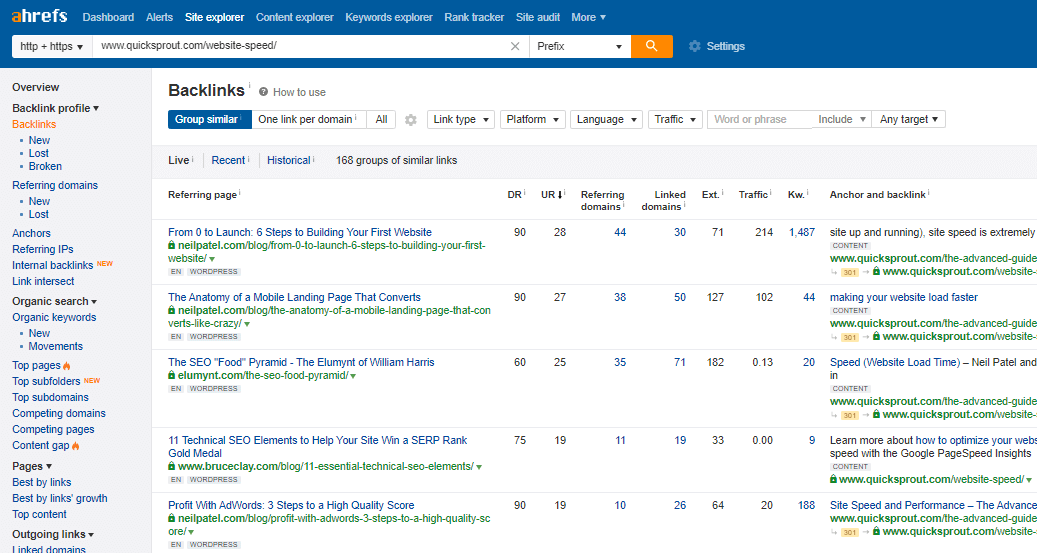
Export this data as a CSV for each competitor. You’ll need it for the gap analysis in the next step.
Step 3: Run a Backlink Gap Analysis
A backlink gap analysis identifies domains that link to your competitors but not to you. These are your highest-probability link prospects because they’ve already demonstrated willingness to link to content in your niche.
In Ahrefs: Go to More → Link Intersect. Enter your domain and up to 10 competitor domains. Ahrefs will show you every domain that links to at least one competitor but not to you.
In Semrush: Use the Backlink Gap tool. Enter up to 5 domains. Semrush categorizes prospects as “Best” (link to all competitors but not you), “Weak” (link to you less than competitors), and “Strong” (link to you more). Focus on the “Best” prospects first.
The gap analysis is the most valuable step in this entire process. It gives you a laser-focused list of sites that are already linking within your niche, which dramatically increases your outreach success rate compared to cold prospecting.
Step 4: Analyze and Filter the Data
Your gap analysis will probably return hundreds or thousands of domains. You need to filter aggressively to focus on links worth pursuing.
Apply these filters:
- DR 40+ — Links from low-authority sites won’t move the needle. One high-authority editorial link generates approximately $9,120 in lifetime value
- Organic traffic 1,000+ — This confirms the site is legitimate and the link can drive referral traffic
- Dofollow links — Prioritize these, but don’t ignore nofollow entirely. 78.8% of SEO professionals believe nofollow links still impact rankings
- Topically relevant — Links from contextually relevant domains carry 68% more ranking weight than irrelevant ones
- Live and active — Check that the linking page still exists and the link is still present
After filtering, sort your remaining prospects by DR (highest first). This is your prioritized outreach list.
Step 5: Classify Link Opportunities by Type
Not every competitor backlink can be replicated in the same way. I classify opportunities into three categories:
Type 1 — Quick Wins (replicate immediately):
- Blog comments on industry sites
- Profile creation on platforms and directories
- Resource page listings
- Forum contributions and community links
Type 2 — Content-Based (require effort):
- Guest posts on authority blogs
- Expert roundups and interviews
- Infographic placements
- Data-driven studies that earn editorial links
Type 3 — Relationship-Based (difficult to replicate):
- Personal connections between site owners
- PR placements from dedicated agency campaigns
- Sponsored or paid links (risky and against Google’s guidelines)
Work through Type 1 opportunities first — these are essentially free backlinks your competitors already have. Then invest time in Type 2 opportunities, which deliver the highest-authority links. Acknowledge that Type 3 links exist but don’t waste time trying to replicate personal relationships you don’t have.
Step 6: Create Content Worth Linking To
Before reaching out to any site, you need content that’s genuinely better than what your competitor published. Nobody will swap a link from a good resource to a mediocre one.
The Skyscraper Technique is the standard approach here: find a piece of content that earned your competitor links, then create something significantly better — more comprehensive, more current, better designed, with original data or visuals.
What “better” means in practice:
- More up-to-date statistics and references (cite 2025–2026 sources)
- Original research, data, screenshots, or case studies
- Better formatting — comparison tables, step-by-step visuals, embedded tools
- Deeper coverage of subtopics competitors only mention briefly
- A unique angle or methodology that adds genuine value
Editorially earned backlinks drive 53% more organic traffic than sponsored placements. The content investment is worth it.
Step 7: Pitch the Website Owner
This is where most people fail. A lazy outreach email will get deleted instantly — most authority sites receive hundreds of link requests every week.
Use these tools to find the right contact:
- Hunter.io — finds email addresses associated with a domain
- ContactOut — extracts contact info from LinkedIn profiles
- FindThatLead — prospecting tool for business emails
Your pitch needs three things:
- Personalization — Reference something specific about their site or the article that contains the competitor’s link. Show you actually visited their page.
- Value proposition — Explain exactly why your content is a better resource for their readers than what they currently link to. Be specific: “My guide includes 2026 pricing data and a comparison table that the current linked resource lacks.”
- Easy action — Tell them exactly what you’re asking for. “Would you consider updating the link in [specific article] to point to my updated guide?” is better than a vague “I’d love to collaborate.”
Follow-up emails increase reply rates by up to 65%. Send one follow-up after 5–7 days if you don’t hear back. Two follow-ups maximum — anything beyond that is spam.
Step 8: Track Results and Repeat
Set up a backlink monitoring alert in Ahrefs or Semrush for your domain. Track which outreach campaigns convert, which angles work, and which types of content attract the most links.
Once you’ve worked through all the opportunities for one keyword, start the process again for the next. The more you do this, the faster and more efficient your workflow becomes. I recommend running a full competitor backlink analysis every quarter to catch new link opportunities as your competitors continue building.
What NOT to Copy From Your Competitors
This is something most guides on competitor backlink analysis skip entirely, and it’s arguably the most important part.
A 2025 survey found that 91.9% of SEO professionals believe their competitors are purchasing backlinks, and 56% doubt Google can effectively identify paid links. That means a significant chunk of the backlinks you discover during your analysis may be paid placements.
Do not attempt to replicate these:
- Paid links — If a competitor has links from sites that look like they sell placements (thin content, excessive outbound links, “write for us” pages with pricing), skip them. The risk isn’t worth it.
- PBN links — Private Blog Networks are easy to spot (similar registration data, boilerplate designs, no real audience). These are a ticking time bomb.
- Relationship-based links — If a competitor got a link because the site owner is their personal friend or business partner, you can’t replicate that through outreach. Move on.
- Links from expired or redirected domains — Google’s March 2024 spam update specifically targets expired domain abuse.
Focus your energy on links that were earned through genuinely good content, legitimate guest contributions, and real editorial value. Those are the links that will still be helping your rankings years from now.
The Honest Math Behind Outreach Success Rates
Most competitor backlink analysis guides make outreach sound easy. Let me give you the real numbers.
The average outreach email response rate is 8.5%. That means for every 100 personalized emails you send, about 8–9 people will reply. Not all replies lead to links — some will say no, some will ask for payment, and some will ghost after the first response.
Here’s a realistic scenario:
| Stage | Numbers |
|---|---|
| Prospects from backlink gap analysis | 500 domains |
| After filtering (DR 40+, relevant, live) | 150 domains |
| Valid email addresses found | 120 contacts |
| Replies received (8.5% rate) | ~10 replies |
| Links secured (30–50% of replies) | 3–5 new backlinks |
That might sound low, but remember: these are targeted, high-quality backlinks from sites that already link to content in your niche. Five DR 50+ editorial links can be worth more than 200 low-quality directory links. According to industry data, a single link builder generates approximately 15.58 links per month — so 3–5 quality links from one campaign is right on track.
The key to improving these numbers: better content wins more links. If your resource is genuinely superior to what the prospect currently links to, your conversion rate climbs significantly.
How Link Velocity Reveals Your Competitor’s Strategy
Most guides only tell you to look at how many backlinks your competitors have. That’s not enough. You also need to analyze how fast they’re building them — this is called link velocity.
In Ahrefs, check the “Referring Domains” graph over time for each competitor. A competitor going from 200 to 800 referring domains in 3 months is running an aggressive (and possibly paid) link building campaign. A competitor gaining 5–10 new referring domains per month is building organically through content marketing.
Ahrefs research shows that most top-ranking pages gain 5%–14.5% more followed backlinks from new websites each month. If a competitor’s link velocity exceeds that range dramatically, they’re likely investing heavily in link building strategies beyond organic content — which tells you what budget and effort level you’re competing against.
Track your own link velocity alongside your competitors’. If they’re outpacing you consistently, you either need to scale your outreach or find more efficient link building channels.
Competitor Backlink Analysis for AI Search Visibility
Here’s something most SEO guides haven’t caught up with yet: competitor backlink analysis isn’t just about Google rankings anymore. It’s about AI search visibility.
AI referral traffic hit 1.13 billion visits in June 2025 — a 357% year-over-year increase. ChatGPT alone drives 77.97% of all AI referral visits to websites. And 47% of AI Overview citations come from pages ranking below position #5 in Google, meaning even mid-ranking pages can earn AI citations if they have the right authority signals.
When you run a competitor backlink analysis, pay attention to which types of domains link to your competitors. If sites like industry publications, .edu resources, or government portals link to them, those are the exact authority signals that AI systems use to select citation sources. Building links from similar authoritative domains can improve both your Google rankings and your visibility in AI-powered search tools.
Also worth noting: unlinked brand mentions now correlate more strongly with AI overview citations than backlinks alone, according to BuzzStream research. Use tools like Ahrefs Content Explorer or Brand24 to find places where competitors are mentioned but not linked — then pitch those sites for links to your own content.
How Often Should You Run a Competitor Backlink Analysis?
Run a full competitor backlink analysis once per quarter. Your competitors are building new links constantly, and new sites enter your SERP landscape every few months.
Between full audits, set up automated alerts in your SEO tool. Ahrefs and Semrush both let you track new backlinks to competitor domains in real time. When a competitor earns a high-authority link, you’ll see it within days and can begin working on replicating it before they build too much of an advantage.
Industry data suggests it takes an average of 3.1 months to see ranking impact from new backlinks. So the sooner you identify and act on competitor link opportunities, the sooner you close the gap.
Summing Up!
Competitor backlink analysis remains the most efficient way to build high-quality backlinks in 2026. Instead of guessing which sites might link to you, you’re working from a proven list of domains that have already linked to content in your niche. With Google’s own leaked documents confirming that PageRank and site authority are still core ranking signals, there’s never been a stronger case for this strategy.
Start with the backlink gap analysis — it’s the single highest-ROI step. Filter aggressively for quality over quantity, create content that’s genuinely better than what’s currently out there, and set realistic expectations for outreach conversions. Do this consistently every quarter, and you’ll steadily close the gap between you and the sites currently sitting in those top positions.
For more SEO best practices and link building strategies, check out the related guides linked throughout this article. And if you want my backlink analysis spreadsheet to speed up the data analysis, grab it here for free.
What is competitor backlink analysis?
Competitor backlink analysis is the process of examining the backlink profiles of websites that outrank you in search results, identifying their strongest links, and then replicating those same links for your own site using tools like Ahrefs, Semrush, or Moz.
What is the best tool for competitor backlink analysis?
Ahrefs is rated the most comprehensive backlink analysis tool by 68.1% of SEO professionals. Its Link Intersect feature lets you compare up to 10 competitors simultaneously. Semrush’s Backlink Gap tool is a strong alternative that compares 5 domains side-by-side with automatic prospect categorization.
How many backlinks do I need to outrank my competitors?
The average top-ranking page has approximately 203 backlinks to reach page one and 521 for top-3 positions. However, quality matters far more than quantity — one DR 70+ editorial link outperforms 30-40 low-authority links. Run a backlink gap analysis to see exactly how many links your specific competitors have.
What is a backlink gap analysis?
A backlink gap analysis identifies domains that link to your competitors but not to you. These are your highest-probability link prospects because they’ve already demonstrated willingness to link to content in your niche. Use Ahrefs Link Intersect or Semrush Backlink Gap tool to automate this process.
How often should I run a competitor backlink analysis?
Run a full competitor backlink analysis once per quarter. Between audits, set up automated alerts in Ahrefs or Semrush to track new competitor backlinks in real time. It takes an average of 3.1 months to see ranking impact from new backlinks, so quarterly analysis keeps you ahead of the curve.
Is it ethical to copy competitor backlinks?
Analyzing and replicating competitor backlinks through legitimate outreach is a standard SEO practice endorsed by Google. What’s unethical is buying links, using PBNs, or manipulating anchor text. Focus on earning links by creating better content than what competitors offer, not by copying their potentially risky tactics.




