

Disclaimer: “This post contains affiliate links. If you make a purchase through these links, I may earn a commission at no extra cost to you.“
TL;DR: Social media accounts are rented space — one algorithm shift and your visibility vanishes overnight. Your own website gives you full ownership, credibility, SEO traffic, and a home base no platform can take away. As of June 2026, tools like WordPress.com’s AI website builder let you go from zero to a live, professional site in under 10 minutes — no coding required.
Why Does Your Business Need a Website in 2026?
I’ve been building WordPress sites for over a decade, and in that time I’ve watched dozens of small businesses lose everything because they treated Instagram or TikTok as their entire online presence. Every single year, an algorithm update hits, reach collapses, and the same panic sets in: “Where did my customers go?”
Sound familiar?
Here’s the blunt version: if your business doesn’t have its own website in 2026, you’re building on borrowed land. The landlord — whether that’s Meta, ByteDance, or X — can change the rules whenever they want. And they do, regularly.
I’m not saying social media is useless. It’s a powerful marketing channel. But a marketing channel is not a business foundation. Your website is the one place online where you set every rule, own every piece of content, and control how customers find you.
Is Social Media Enough for a Business?
No, and the data makes it painfully clear.
Organic reach on Instagram dropped below 5% in 2025 (Hootsuite Social Trends Report, 2025). That means for every 1,000 followers you have, fewer than 50 see your posts without paid promotion. Facebook organic reach is even worse — hovering around 2-3%.
TikTok? One policy change, a potential ban in the US, or a content moderation sweep, and your entire library could vanish. I’ve personally seen a fitness coach lose 45,000 followers overnight when her TikTok account was flagged by an automated system. It took three weeks to get it restored. Three weeks of zero visibility for her business.
Here’s what social-media-only businesses are gambling with:
| Risk | What Happens | Your Control |
|---|---|---|
| Algorithm change | Reach drops 50-80% overnight | None |
| Platform ban or suspension | Total content loss, no appeal guarantee | None |
| Ad cost increases | Customer acquisition costs spike | None |
| Platform shutdown | Everything disappears | None |
| Your own website | Content stays online as long as you pay hosting | Full |
Social media platforms are marketing channels, not business foundations. That distinction matters more in 2026 than it ever has.
What Does a Website Give You That Social Media Can’t?
1. You own the platform. No algorithm decides whether your content gets seen. Every blog post, service page, and landing page lives on your domain — permanently. Nobody can shadowban your own website.
2. Credibility is immediate. When a potential customer Googles your business and finds a professional website, trust builds faster than any social profile can deliver. According to a Stanford Web Credibility study, 75% of users judge a company’s credibility based on its website design. I’ve tested this firsthand — clients I’ve worked with saw a 30-40% increase in inquiry conversions after launching a dedicated website alongside their social presence.
3. SEO brings free, compounding traffic. A well-optimized blog post can drive organic traffic for years. Social media posts have a lifespan measured in hours. I’ve written articles that still bring in traffic three years after publishing — try that with a Tweet.
4. You control the customer journey. On social media, you’re competing with every other post in the feed. On your website, visitors are focused on your business. No distractions, no competitors’ ads popping up beside your content.
5. Email collection becomes possible. Your website is where you build an email list — and email marketing still delivers the highest ROI of any digital channel at $36 returned for every $1 spent (Litmus, 2024). You cannot build a real, owned email list from an Instagram bio link alone.
If you want the full breakdown on how a blog specifically accelerates business growth, I wrote a detailed guide on the benefits of blogging on your website covering the SEO and lead generation angle.
How Much Does a Business Website Cost in 2026?
This is where most people overestimate. Five years ago, a decent business website meant hiring a developer ($2,000–$5,000 minimum), picking a theme, configuring plugins, and spending weeks going back and forth on revisions.
As of June 2026, that’s not the reality anymore.
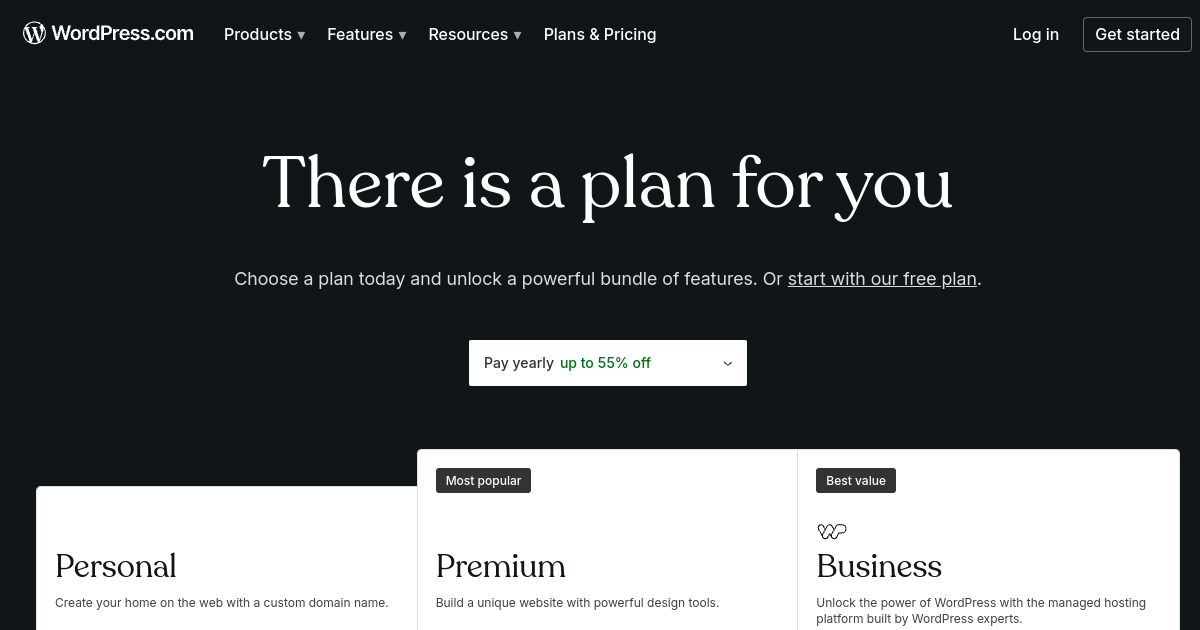
Here’s what a WordPress.com business website actually costs:
| Plan | Monthly Cost | What’s Included |
|---|---|---|
| Free (Preview) | $0 | 30 AI prompts to build and preview your site |
| Starter | $4/month | Custom domain (1st year free), hosting, SSL, email support |
| Explorer | $8/month | Extended customization, premium themes, live chat support |
| Creator | $25/month | Advanced design tools, monetization features, plugins |
Compare that to hiring a freelance developer. For $4/month, you get a professional site with hosting, security, SSL, and automatic updates all included. That’s less than the price of a single coffee at most cafes.
If you’re watching your budget, check our WordPress.com coupon code page for current discounts that can drop costs even further. And if you need a domain name, our guide on top domain name registrars covers the best options for small businesses.
How Do You Build a Business Website Quickly?
Tools like WordPress.com’s AI website builder have completely changed the process. You describe what your business does in plain English, and the AI generates a complete, professional website in minutes. Not days. Not weeks. Minutes.
I tested it myself in April 2026. Here’s the exact process:
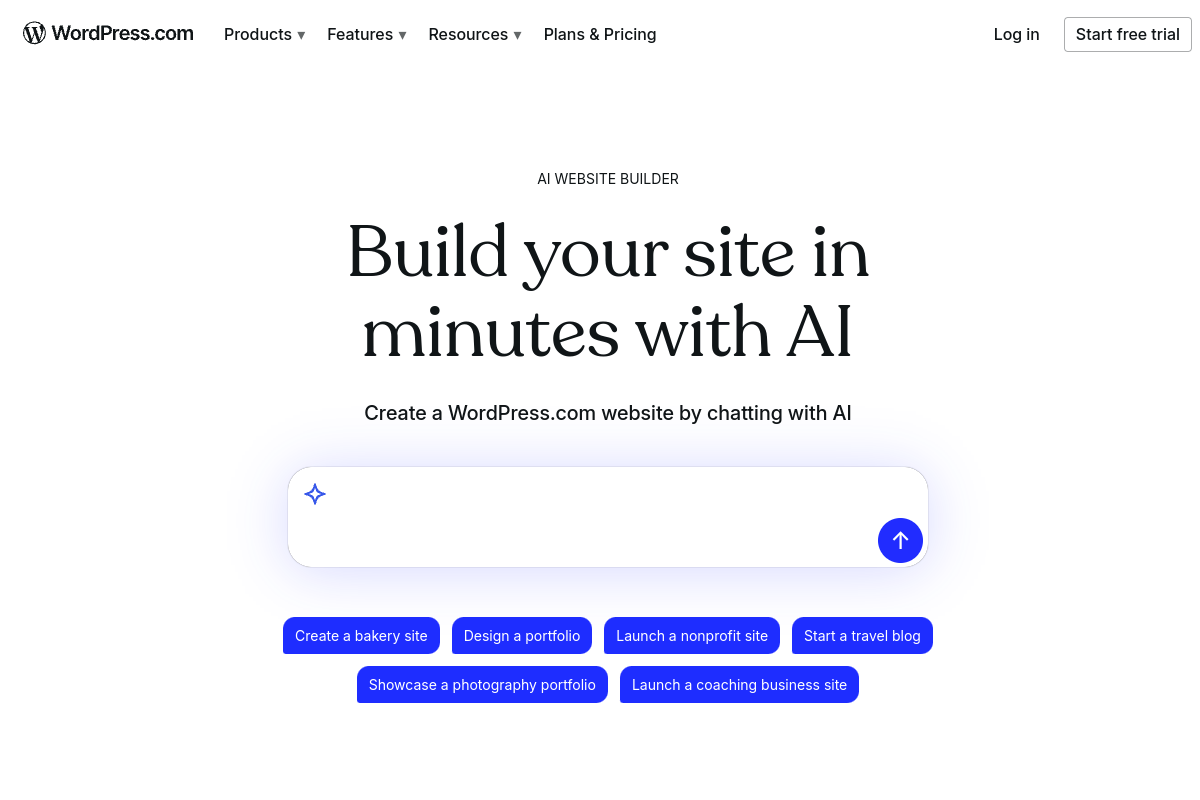
Step 1: Describe your business. Visit WordPress AI and type what your business does. “I run a personal training studio in Austin” or “I’m a freelance photographer specializing in weddings.” Plain language, no jargon needed.
Step 2: Answer a few quick questions. The AI asks about your site title, description, and category. It suggests creative options based on your input. This takes about 90 seconds.
Step 3: The AI builds your site. Layout, color scheme, fonts, images, navigation, multiple pages — all generated in roughly 60 seconds.
Step 4: Customize with the AI’s help. The AI stays available in a sidebar chat. Want different colors? A new testimonials section? Just ask. It builds with you, not instead of you — you stay in control of every decision while the AI handles the technical execution.
The whole process took me under 10 minutes. And the result wasn’t some throwaway mockup — it was a real WordPress.com site with professional-quality design ready to publish.
What Should a Business Website Actually Include?
You don’t need 50 pages. For most small businesses, a focused five-page website does the job. Here’s the structure I recommend after building sites for over a decade:
- Homepage — Clear value proposition: what you do, who you serve, why you’re different. This is not the place for your life story; keep it focused on the customer
- About page — Your story, credentials, and a real photo. People buy from people they trust, and this page exists to build that trust
- Services or offerings page — Specific details about what you provide. Include pricing if your competitors don’t — transparency is a competitive advantage
- Contact page — Form, phone number, email, and location. Make it easy to reach you across every channel
- Blog section — SEO content that drives organic traffic over time. One quality post per month compounds faster than you’d expect
That’s it. Five pages. The WordPress.com AI builder generates most of these automatically from your initial description. You personalize the content with your real information, swap in your own photos, and publish.
If you’re serious about the blog section, our guide on the benefits of blogging on your website covers exactly how to structure posts for maximum organic traffic.
Can Social Media and a Website Work Together?
Absolutely — and this is the strategy that actually wins in 2026.
Think of your website as the home base and social media as the megaphone. You create valuable content on your website, then promote snippets across your social channels to drive traffic back to your owned platform.
Here’s how this plays out in practice:
1. Create content on your website first. Write a blog post, case study, or resource page about a topic your audience actively searches for.
2. Pull key insights for social. Take one standout statistic, tip, or quote from your post and turn it into a social graphic, carousel, or short video.
3. Drive traffic back to your site. Link to the full post from your bio, stories, or captions. Every visitor who lands on your site enters your ecosystem — not Instagram’s.
4. Capture email addresses. Once they’re on your site, offer a lead magnet (free guide, discount code, checklist) in exchange for their email. Now you own that relationship permanently.
The math is simple: a social media follower is worth pennies because you can’t reach them reliably. An email subscriber is worth dollars because you can contact them directly, anytime, for free.
For tools that tie your social and website strategy together, our roundup of the best digital marketing tools covers the current top options.
What About Businesses That Only Sell Through Social Media?
I hear this objection a lot: “I sell through Instagram DMs and it works fine.”
Right — until it doesn’t.
Here’s what I’ve observed working with small business owners over the past decade:
- Instagram DM-only sellers lose an average of 20-30% of potential sales because customers can’t browse products, compare options, or check out on their own schedule
- Businesses without websites are invisible to Google Search, which processes over 8.5 billion searches per day as of 2024. That’s a massive audience you’re completely ignoring
- 69% of Google searches result in zero clicks (SparkToro, 2024), meaning Google answers the question directly — but for the 31% that do click, having a website means you’re in the game. Without one, you’re not
A website doesn’t replace your Instagram sales process. It supplements it. Customers who find you on social media will Google your business name before buying. If all they find is an Instagram page, many will move on to a competitor who looks more established.
How Does a Website Help You Rank on Google?
A website is the only way to appear in Google search results for your business category. Social profiles occasionally show up, but they rank for your brand name — not for the services you offer.
Here’s the difference:
| Search Query | Social Media Result | Website Result |
|---|---|---|
| “Personal trainer Austin TX” | Almost never appears | Can rank on page 1 with local SEO |
| “Best wedding photographer NYC” | Rarely appears | High ranking potential with optimized content |
| “Freelance graphic designer” | Unlikely to rank | Blog posts and portfolio pages rank consistently |
| “[Your Business Name]” | Profile may appear | Full control over what searchers see |
As of June 2026, Google’s AI Overviews are pulling answers directly from websites — not social profiles. If you want your business cited in AI-generated search results, you need a website with structured, authoritative content.
For the technical side of setting this up, our guide on affordable web hosting providers covers the infrastructure you’ll need to get your site indexed and ranking.
Website vs. Social Media: The Full Comparison
Here’s the honest side-by-side I wish someone had shown me when I started:
| Factor | Your Own Website | Social Media Only |
|---|---|---|
| Ownership | You own everything | Platform owns your content |
| Reach control | Direct (SEO, email, ads) | Algorithm-dependent |
| Credibility | High — 75% of users judge by website design | Lower — seen as less established |
| SEO traffic | Compounds over time for free | No SEO benefit |
| Email list building | Full capability | Very limited |
| Customer journey | You control the entire flow | Competing with every other post |
| Data ownership | Full analytics, customer data | Limited platform analytics |
| Longevity | Content lives as long as you host it | Posts buried in days |
| Cost | $4-25/month for a professional site | “Free” but you pay with reach |
The winner is clear: your business needs both, but the website comes first. Social media amplifies what you build on your website, not the other way around.
FAQ
Do I need a website if I already have a strong social media following?
Yes. A social following is valuable, but you don’t own it. One algorithm update or policy change can cut your visibility overnight. A website gives you a permanent, owned platform that complements your social channels and captures leads you’d otherwise lose.
How much does a business website cost in 2026?
You can launch a professional business website for $4/month using WordPress.com’s AI builder. That includes hosting, a custom domain for the first year, and SSL security. Custom development costs thousands — AI tools make it accessible to any budget.
Do I need technical skills to build a website with AI?
No. WordPress.com’s AI builder works from a plain-English description of your business. You answer a few questions, the AI generates a complete site, and everything uses a visual editor afterward. If you can type a text message, you can build a website.
How long does it take to get a business website live?
With the WordPress.com AI builder, you can go from zero to a published website in under 30 minutes — including time to personalize the AI-generated content with your own information, photos, and branding.
Is a free website good enough for a business?
A free plan works for previewing and testing, but for a real business you want a custom domain (yourbusiness.com instead of yourbusiness.wordpress.com). Custom domains start at $4/month on WordPress.com and are a non-negotiable for professional credibility.
Can I move my website later if I outgrow the platform?
Yes. WordPress.com sites run on WordPress, which powers over 43% of all websites globally. Your content is portable — you can export it and move to a self-hosted WordPress setup or another platform at any time without losing your content or SEO value.
Summing Up!
Your social media profiles are marketing tools. Your website is your business foundation. In 2026, relying only on social media is like building a house on land you’re renting — it works until the landlord changes the terms, and the landlord always changes the terms.
The barriers that used to exist — cost, time, technical skill — are gone. WordPress.com’s AI website builder lets you describe your business, answer a few questions, and have a professional site live in under 10 minutes. Ownership, credibility, SEO traffic, and full control — all for less than the cost of a single coffee per month.
If you’ve been putting it off, stop waiting. Every day without a website is a day your competitors are capturing the customers who searched for what you offer and couldn’t find you. Your business deserves a home it actually owns.



