8 Best Facebook Ad Agencies in 2026
Compare the best Facebook ad agencies of 2026 by strengths, ideal clients, and pricing transparency, plus five questions to ask before you sign.

Most "best Facebook ad agencies" pages rank shops by how confidently they sell themselves. The same names recycle through Google, each introduced with language lifted from its own about page, and almost none say whether they will take a $4,000 monthly budget, who owns the ad account, or what creative volume the retainer buys.
Facebook turned advertising into a professional service category on 6 November 2007, when it launched Facebook Ads alongside Pages for brands, tying ad delivery to social actions from a user's friends (Clarigital's Facebook ads history). Almost two decades of auction-based, algorithmic delivery later, every shop can claim platform fluency, while self-reported case studies still substitute for last quarter's account.
Supply keeps growing. In 2024, 49% of agency professionals expected client budgets to increase, while 43% expected them to stay flat, according to Digiday+ Research. Plenty of shops are chasing the same retainers, which makes polished positioning a weak filter.
The useful question is fit: spend level, business model, and creative needs. Below are the agencies worth shortlisting: Knowlify, LYFE Marketing, Sociallyin, Disruptive Advertising, Tinuiti, MuteSix, Common Thread Collective, and Hawke Media. Each profile flags the gap to close before signing: unpublished pricing, self-reported figures, or unclear account ownership. Ask what happens when performance dips in week two, how many tests ship monthly, and whether the person pitching runs the account.
1. Knowlify
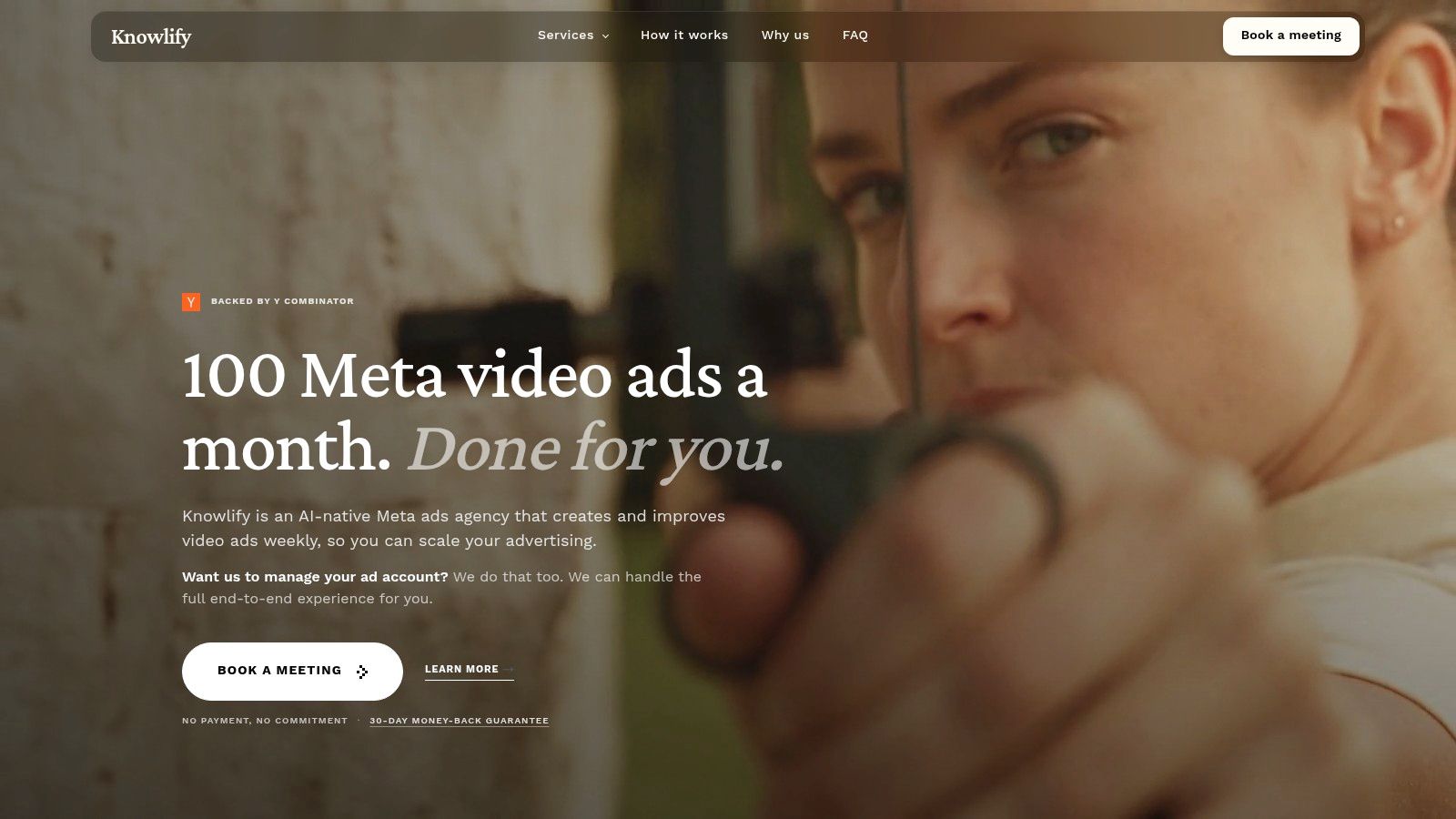
Almost every agency on this list sells media management and treats ad creative as a line item or an upsell. Knowlify runs the inverse model. It is a done-for-you AI video advertising agency for B2B and B2C companies on paid social, and what you buy is finished video: concepts, scripts, production, editing, and sound, with a human quality check before anything ships.
What the first two weeks look like
Knowlify's Y Combinator profile describes onboarding as a 20-minute kickoff call, creative direction out for approval within 48 hours, and the first finished batch five days after that call. Its Meta ads agency page says monthly plans then ship roughly 100 finished ads a month, in weekly batches of about 25. Treat those as throughput claims to test on the call: ask whether the count means concepts or deliverables, and how revisions affect the clock.
Three formats cover most briefs: AI UGC ads that read like a creator shot them on a phone, Pixar-style character animation for products that are awkward to film, and AI commercials for launches and promotions. That spread matters because creative fatigue is what usually stalls a Facebook account around month three, long after audiences and bids have been tuned.
Where it fits, and where it doesn't
- Production only: choose this if a media buyer or in-house team already runs the account and the bottleneck is a steady creative pipeline.
- Production plus campaign management: choose this if you want Facebook and Instagram buying handled by the same team producing the ads, so hook testing and bid decisions stay in sync.
- What it costs: plans start at $5,000 a month on its own page, with the exact quote after a call and no annual contract.
- What stays yours: media spend is separate from the production fee, and clients keep their ad accounts and every finished ad.
Skip Knowlify when the main problem is measurement. Broken attribution or a CRM that never communicates back to Meta will make even strong creative look average.
Ask on the call: of the weekly output, how many ads are net-new concepts, how many are re-cuts of a proven winner, and who owns the ad account if the engagement ends?
Knowlify is backed by Y Combinator (Summer 2025). Its ad examples and booking sit on the Meta ads agency page.
2. LYFE Marketing
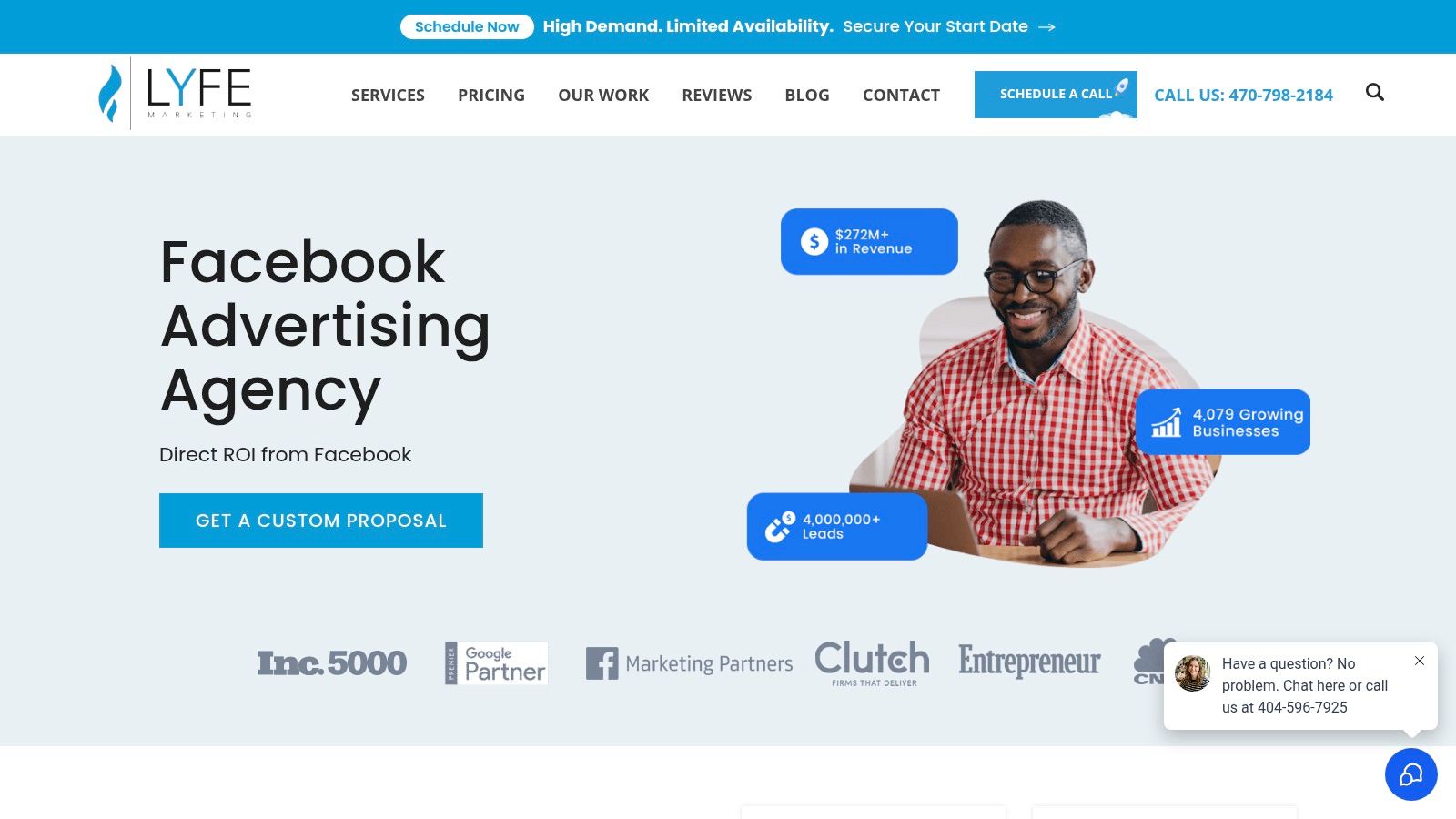
LYFE Marketing built its book of business on small and local advertisers rather than national brands, and the packaging reflects it. Facebook and Instagram campaign management sits alongside strategy, ad creation, targeting, conversion tracking, retargeting, and reporting, so a business without a marketing hire can hand over the whole channel instead of stitching three freelancers together.
The benchmark to hold them to
Judge a lead-gen agency against the objective, never the account average. WordStream's 2025 Facebook ads benchmarks, built from more than 1,000 campaigns, put median click-through at 1.71% for traffic campaigns and 2.59% for lead campaigns. Lead campaigns converted at a 7.72% median rate, with an average cost per lead of $27.66 and a $1.92 CPC. If a proposal quotes one click-through rate for your entire account, ask which campaign objective it came from.
- What works: small-business orientation, lead-gen and ecommerce campaign experience, and more published package detail than most full-service shops.
- What to watch: the package structure can be less flexible than a fully custom engagement, and the agency's own pages present different pricing information, so get the number in writing.
- Self-reported results: published performance figures are the agency's own and don't transfer to your account.
Small budgets live or die on the offer and the landing page, not on targeting sliders, which is why creating engaging content for your target audience comes before you spend a dollar on distribution.
3. Sociallyin
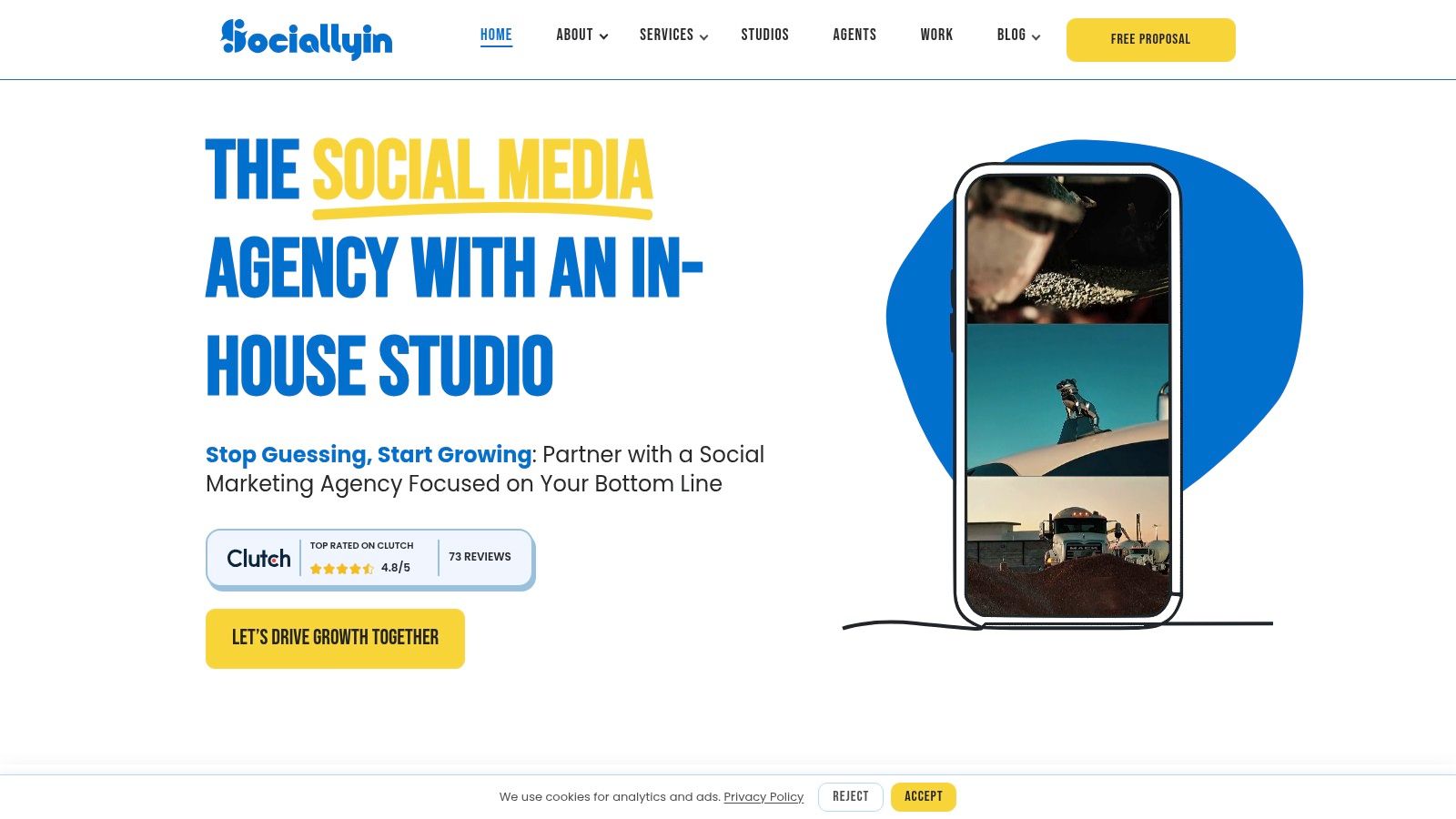
Sociallyin is a social media agency that also buys paid social, which is a different animal from a media buyer who happens to write captions. Paid social and campaign optimization sit alongside social strategy, content production, community management, influencer marketing, and analytics, with an in-house studio feeding the ad account.
Where the studio earns its keep
You buy Sociallyin when the ads and the organic feed should look like they came from the same brand. Coordinating campaign buying with content production removes the handoff where the paid team discovers the only usable footage is a year old and vertical video doesn't exist. The client list includes recognizable names such as Samsung and Carnival Cruise Line.
The reverse is also true. If all you need is someone to run Facebook campaigns and you already produce your own creative, a broader social relationship is overhead you'll pay for and not use.
- Strength: one team buying media and producing the social-first assets that media needs.
- Watch the scope: ask directly how much creative production is included in the monthly fee versus billed as a project.
- Pricing: proposal-based, with no public rate card, so compare total cost rather than the headline retainer.
Creative volume is a scope question, not a talent question. Ask how many net-new assets land each month before you judge a showreel.
If you're weighing whether to build this capability internally instead, this guide to how to start a social media marketing agency covers the service mix and the pricing models you'd be competing against.
4. Disruptive Advertising
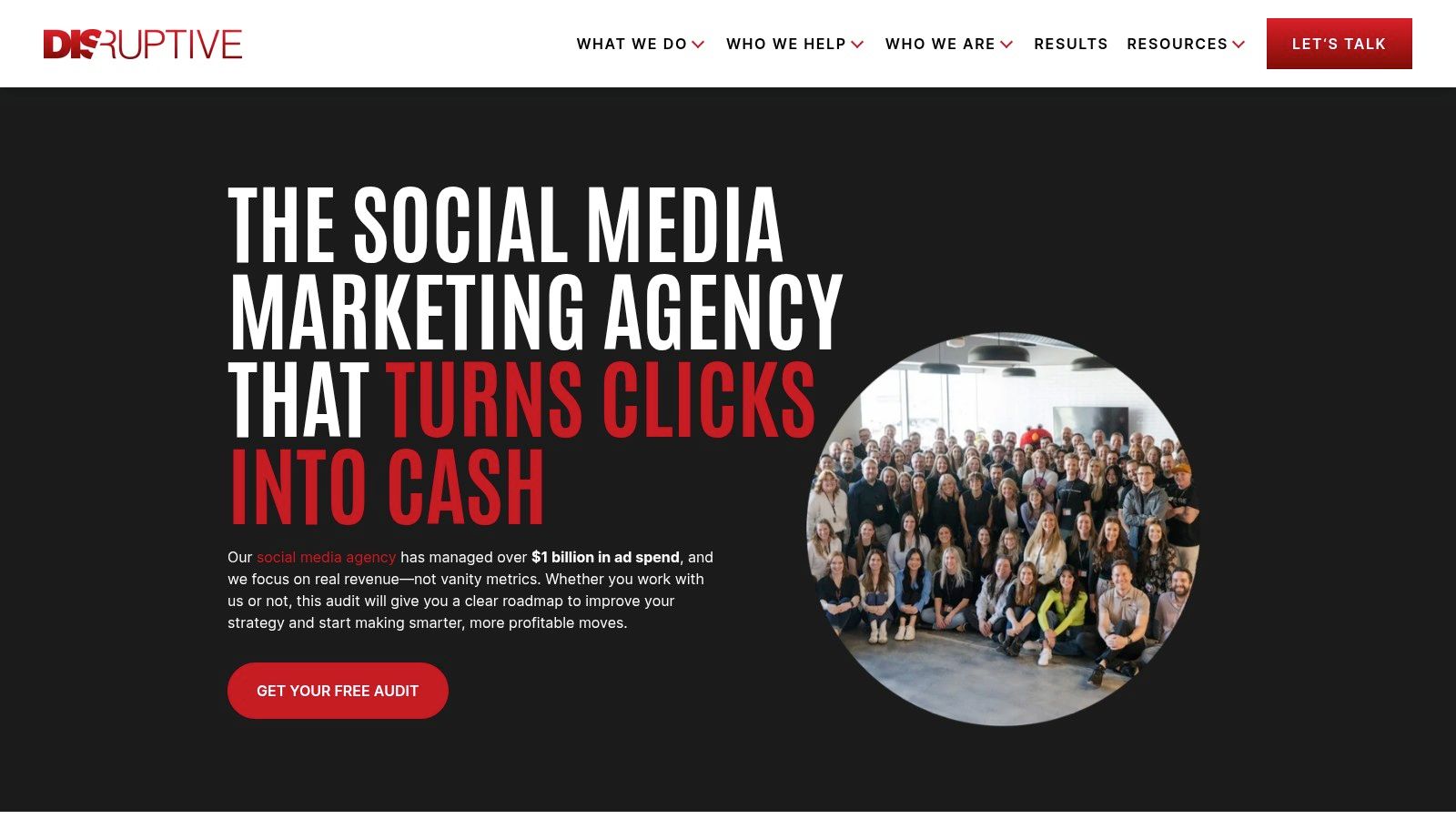
Say you run Facebook ads for a dental group and also buy Google Search. Two vendors, two dashboards, two definitions of a qualified lead, and a monthly argument about which channel deserves the credit. Disruptive Advertising exists to collapse that problem: paid social across Meta and other platforms, with targeting, creative, and conversion-focused optimization sitting inside a wider paid media operation.
The case for and against one vendor
Running Facebook alongside search and other channels under one roof means the conversion tracking, the landing pages, and the bid strategy get decided once. The agency's published case studies cover ecommerce and lead generation, so you can at least read what the work looked like before you sit through the pitch.
The trade-off is attention. A broad paid media shop puts its strongest people on the accounts with the largest budgets, and a narrow, low-budget Facebook-only campaign rarely qualifies. That's not a knock on the agency. It's a reason to be honest about your size before booking the call.
- Ask about pricing and minimums: the service page doesn't list them, so get the engagement floor and the management fee in writing.
- Ask who runs the account: the name of the person, their other clients, and how many hours a week your account gets.
- Ask the reporting cadence: weekly or monthly, and whether platform-attributed conversions get reconciled with your CRM.
If you'd rather own the stack yourself, the best digital marketing tools covers the tracking, reporting, and automation layers a paid media team relies on day to day.
5. Tinuiti
Tinuiti is the enterprise entry, and it's the one to shortlist if your Facebook buying can't be separated from measurement. Its Meta service covers Facebook and Instagram campaign planning, creative testing, funnel-oriented strategy, audience planning, and analytics, wrapped in broader paid-social capability across channels.
Scale, and the honest limits of it
Meta reported approximately $200.97 billion in total revenue for 2025, with advertising at about $196.18 billion, roughly 97.6% of company revenue. Facebook reached approximately 3.07 billion monthly active users in the fourth quarter of 2023, before Meta shifted reporting to Family Daily Active People, per Axis Intelligence's Meta statistics.
That scale supports two conclusions. Local campaigns and multinational ones run on the same auction, so size alone proves nothing about an agency. And because Meta reports advertising revenue across Facebook, Instagram, Messenger, and WhatsApp rather than breaking out Facebook alone, any shop quoting a Facebook-only revenue figure is inventing it.
A report that can't separate Facebook-attributed conversions from Instagram and Advantage+ placements is telling you what the account did, not what your Facebook ads did.
- Where it fits: established advertisers with real spend, first-party data, and a measurement problem worth solving.
- Where it doesn't: first-time advertisers and very small businesses, who will pay enterprise rates for a scoped-down service.
- Get in writing: pricing and minimum spend, since neither is published, plus how much of the work is platform-attributed versus reconciled to revenue.
Worth reading alongside your own site strategy: why a business needs to own a website rather than relying only on social media for the conversions your ads are paying for.
6. MuteSix
Direct-to-consumer brands hit the same wall. The creative that got you to your first few thousand orders stops working once the easy audiences are exhausted, and the account needs a volume of new hooks that nobody in-house can produce. MuteSix is built around that specific problem: Meta advertising for DTC brands, combining media buying with creative production and iterative testing.
What the DTC focus buys you
The ecommerce vocabulary shows up in how the work is framed. Conversion rate, average order value, and customer lifetime value are the metrics under discussion rather than impressions. The agency identifies itself as a Meta Business Partner, and it runs paid social creative plus creator or influencer content as part of the testing loop.
That's a highly useful combination for a product brand that can turn around new offers, bundles, and angles quickly. It's a poor fit for a plumber, a law firm, or a content business where the conversion event is a call or a subscription, and the DTC playbook doesn't map.
- Pin down production volume: how many new assets per month, in which formats, and who writes the hooks.
- Pin down usage rights: whether creator content can be reused in organic and on the website, and for how long.
- Pin down the extra costs: creator fees, editing, and licensing often sit outside the retainer, and pricing isn't posted on the service page.
Ask for a cohort of two or three clients at your exact spend level, then ask what changed in month four when creative fatigue set in.
7. Common Thread Collective
Common Thread Collective manages Meta against contribution margin rather than the ROAS figure in Ads Manager, and it says the service is aimed at brands spending $100,000 or more per month on Meta. That single sentence disqualifies the agency for most readers, and it's also the most honest positioning on this list.
Why the margin framing is correct
The math behind it is unforgiving. A 2025 dataset covering roughly 35,000 ecommerce brands reported median Facebook and Instagram results of a $13.48 CPM, 2.19% CTR, 1.57% conversion rate, $38.17 CPA, and 1.93 ROAS, with median ROAS ranging from 1.17 in media and publishing to 2.54 in automotive (AdsUploader's Meta ads statistics). A nominal 1.93 platform ROAS can still lose money once fulfillment, discounts, returns, and agency fees land on the P&L.
So the agency's method, creative strategy tied to forecasting, incrementality testing, and lifetime-value analysis, is the right shape of work for a scaled brand. Its scope also includes ecommerce growth planning and related creative services, which means fewer vendors to brief.
- Fit: scaled ecommerce brands with historical sales data, cohort data, and a margin model they trust.
- Not a fit: beginners, local businesses, and anyone below the stated monthly Meta spend threshold.
- Ask before signing: whether reporting shows contribution-margin ROAS and blended MER, not just platform ROAS.
Retention and repeat purchase are where margin math usually breaks, and the best email marketing tools for small businesses matter as much as the ad account when a large share of revenue comes from the existing list.
8. Hawke Media
Hawke Media sells Facebook and Instagram paid social inside a much wider menu, and it's candid about the sequence: audit the brand, build a focused plan, implement, then review performance. Campaigns also run across LinkedIn, Pinterest, TikTok, and Snapchat, so the same team can move budget when a channel stops earning it.
The audit-and-plan starting point
A defined first phase is useful when you've inherited a mess. An audit that names the tracking gaps, the wasted placements, and the audience overlaps gives you something to hold the agency to in month two. It also gives you an exit ramp: if the plan reads like a generic template with your logo on it, you've learned that before signing a twelve-month agreement.
The risk runs the other way too. A full-service shop carries coordination overhead, and a Facebook-only project doesn't need five channel specialists on the account. You'll also want to know whether the audit is billable, whether the plan is produced by the person who will run the account, and how often performance gets reviewed after launch.
- Choose it if: you plan to expand past Facebook within two quarters and want one vendor managing the transition.
- Skip it if: you have one channel, one offer, and a tight budget that a broader retainer would thin out.
- Confirm the basics: pricing and engagement minimums, which aren't published, plus account ownership and review cadence.
The eight Facebook ad agencies at a glance
Eight shops, eight different jobs. Read the table as a filter for fit rather than a ranking: the columns that matter are who each agency suits and what it keeps off the public page.
| Agency | Best for | Specialty | Pricing transparency | Ideal spend level |
|---|---|---|---|---|
| Knowlify | Teams needing done-for-you video ads for paid social | AI UGC, animated ads, and commercials; optional Meta campaign management | Plans start at $5,000 a month; exact quote after a call; media spend is separate | Flexible; confirm scope and budget in proposal |
| LYFE Marketing | Small businesses and newer advertisers | Facebook and Instagram campaign management, creative, and tracking | Some package details are published; confirm current pricing | Small-business budgets; confirm package fit |
| Sociallyin | Brands wanting paid social alongside broader social services | Paid campaigns, in-house content production, and social strategy | Proposal-based | Brands investing in paid social and supporting content |
| Disruptive Advertising | Businesses coordinating Meta ads with other marketing channels | Paid social, creative, audience targeting, and optimization | Pricing and minimum spend are not clearly listed | Growth-focused budgets; confirm minimum |
| Tinuiti | Established advertisers seeking scale and measurement | Meta campaign strategy, creative testing, analytics, and optimization | Public pricing and minimum spend are not listed | Substantial campaign budgets |
| MuteSix | Direct-to-consumer brands needing fresh creative | Meta media buying, creative production, and iterative testing | Pricing is not posted | DTC brands investing in ongoing creative and campaigns |
| Common Thread Collective | E-commerce brands focused on profitable growth at scale | Meta strategy tied to margins, forecasting, and incrementality | Pricing is not publicly listed | $100,000 or more per month on Meta |
| Hawke Media | Brands expanding paid social across multiple platforms | Facebook and Instagram ads with broader marketing support | Pricing and engagement minimums are not published | Multi-channel marketing budgets |
Only three rows volunteer anything about money before a sales call: Knowlify publishes a starting price, LYFE Marketing publishes some package details, and Common Thread Collective names a monthly Meta spend level. The rest route pricing through a proposal, so treat the transparency column as your question list and get every minimum in writing.
How to Choose: Five Questions That Filter Out the Wrong Agency
Run these five on every sales call, in this order. The answers tell you more than any case study PDF.
- What is the minimum monthly ad spend and the total engagement cost, in writing? A shop that won't put a number in an email before a contract exists will surprise you later. Get the management fee, the creative fee, and the minimum media spend separately.
- Who owns the ad account, the pixel, and the data if we part ways? The answer must be you, inside your own Business Manager, with your own pixel and historical conversion data. An agency that owns the asset has a hostage, not a client.
- Are the case studies self-reported, and can you speak to a current client at my spend level? Ask for the monthly ad spend in each case study. A result achieved at ten times your budget doesn't transfer, and a reference call at your level is the only proof.
- How much of the fee goes to creative production versus media management? If production is 15% of the fee, expect two new ads a month and plan for fatigue. If it's most of the fee, ask who's watching the bid strategy.
- What will the first 30 days involve? You want audit, tracking setup, audience build, and a first creative batch. If the answer is "strategy and alignment," the work starts in month two and you're paying for meetings.
Then match by profile rather than by ranking. A small local business belongs with LYFE Marketing. A creative-led social brand fits Sociallyin or MuteSix. Multi-channel coordination points to Disruptive Advertising or Hawke Media. Scale and measurement needs Tinuiti. High-spend ecommerce that cares about margin points to Common Thread Collective. And if the bottleneck is creative volume rather than buying, Knowlify ships ads weekly while you keep the media budget.
The best agency is the one whose minimum engagement matches your budget and whose reporting ties ad spend to business outcomes, not platform dashboards.
If you decide to prove the concept in-house before handing over a retainer, that's a reasonable first move. Run 30 days of your own campaigns against a benchmark you set in advance, then hire with a brief built from real numbers instead of a sales deck. For the groundwork around the ads, TheGuideX publishes free guides on content planning, SEO, and marketing tools.
SEO Specialist and product builder with 10+ years in search. The notes come from the work, not the theory.