Plumber Lead Generation: The Complete 2026 Playbook
Plumber lead generation playbook for 2026 with proven tactics for local SEO, Google Ads, referrals, reviews, CRM tracking, and follow-up scripts that book jobs.

On this page
- Why Most Plumbers Leak More Leads Than They Generate
- Rank in the Local Pack with Google Business Profile and On-Page SEO
- Buying Paid Leads Without Burning the Budget
- How benjiads Can Help
- Referrals, Partnerships, and Reactivation as an Owned Pipeline
- Speed-to-Lead, Reviews, and the Reputation Flywheel
- Tracking, CRM, and the Offline Tactics That Still Print Jobs
- Your 90-Day Plumber Lead Generation Plan
Most plumber lead generation advice starts in the wrong place. It tells you to buy more clicks, open more channels, and chase more volume. That sounds good until you look at the dispatch board and realize half the problem isn't demand. It's what happens after the phone rings.
A lot of shops don't have a lead shortage. They have a lead leakage problem. Calls hit voicemail. Form fills sit until lunch. Someone texts after hours and gets nothing back. A tech takes a call from under a sink, qualifies it badly, and books the wrong job. Then the owner says marketing isn't working and buys more leads.
That's backwards.
The shops that grow usually tighten intake first, then add channels. They stop treating plumber lead generation like a traffic problem and start treating it like an operational system. Once that system is tight, local SEO, Google Ads, referrals, reactivation, and even AI discovery all get stronger.
Why Most Plumbers Leak More Leads Than They Generate
The fastest way to waste money in plumber lead generation is to pour ad spend into a weak intake process.
The pricing gap alone should make you slow down before buying more volume. A large 2026 plumbing Google Ads benchmark found non-branded search campaigns averaged $183 cost per lead, while Performance Max averaged $82 per lead, and Local Services Ads averaged $57 per lead with a 44.5% book rate across U.S. campaigns tracked at scale, as reported in this plumbing lead generation benchmark. That's not a small difference. It means channel choice matters, but handling matters even more.
If your team misses calls, lets forms age, or books weak jobs badly, even the cheaper lead source becomes expensive.
Where the leaks usually happen
Most leaks show up in a handful of places:
- Voicemail during live service hours. Emergency callers don't wait around.
- Slow form follow-up. A web lead without instant contact gets cold fast.
- Bad intake questions. If whoever answers can't separate emergency, estimate, warranty, and low-value tire-kickers, the board fills with junk.
- No missed-call text-back. Plenty of homeowners prefer to reply by text once they've moved on from the call.
- Weak scheduling discipline. Some shops "take the lead" but never pin down a real appointment.
- No-show drift. The job was technically booked, but nobody confirmed, reminded, or rescued it.
| Leakage Point | Typical Loss Rate | Recoverable Jobs per 100 Leads |
|---|---|---|
| Slow callback on web forms | High | Significant |
| Missed inbound calls | High | Significant |
| Weak call intake and qualification | Moderate to high | Meaningful |
| No text follow-up after missed calls | Moderate | Meaningful |
| No appointment confirmation | Moderate | Meaningful |
The exact numbers in that table will vary by shop. The point is simple. Most of these losses are recoverable without buying a single extra click.
Fix booking rate before buying traffic
Here's the plain-English math. If a shop gets 40 monthly leads and books 30%, that's 12 booked jobs. If the same shop tightens call answering, form routing, and follow-up and gets to 50%, that's 20 booked jobs. Same lead flow. Better handling.
That kind of lift usually costs less than another round of ad spend because you're fixing process, not entering another auction.
Practical rule: Before you increase budget, make sure every lead gets answered, tagged, qualified, and scheduled the same way every time.
A lot of business owners need basic tracking before they need another campaign. If your marketing and intake still live in memory, a primer on business marketing fundamentals for small companies can help frame the system side of this.
The contrarian truth is this. Stopping leaks is the cheapest plumber lead generation channel you have. Everything else sits on top of it.
Rank in the Local Pack with Google Business Profile and On-Page SEO
Local pack visibility still drives some of the cleanest inbound calls because the homeowner is already searching with local intent. If your Google Business Profile is weak, incomplete, or inconsistent with your site, you make ranking harder and trust lower at the same time.
Start with the profile before you start obsessing over blog posts.
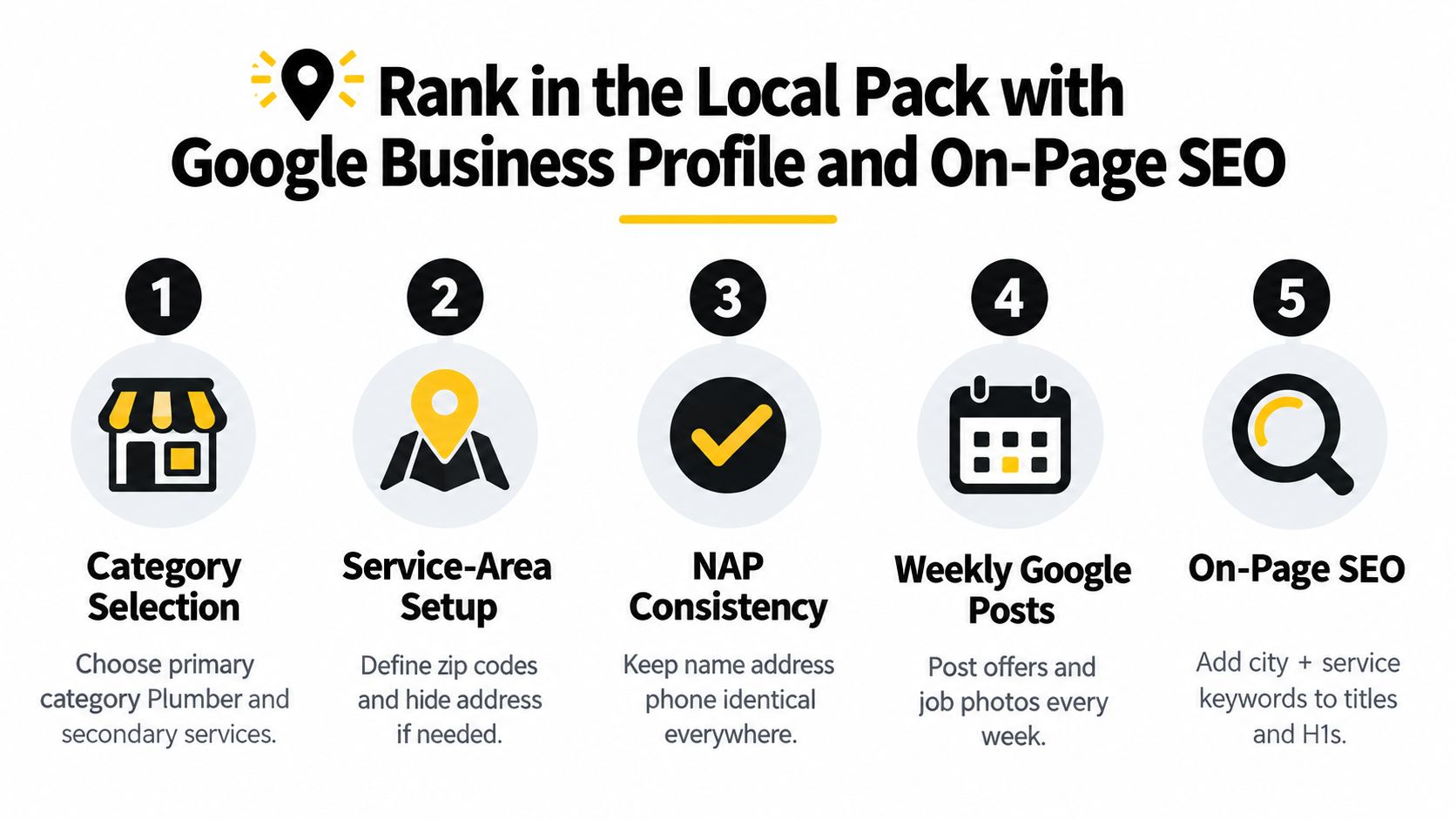
Build the profile like it has to book calls
A plumbing profile that ranks and converts usually has the basics nailed first:
- Primary category right. Use Plumber as the primary category if that's the core trade, then add relevant secondary categories tied to services.
- Service areas set deliberately. Don't spray every nearby town just because it's on a map. Pick the ZIP codes and cities you can service profitably.
- NAP consistency locked down. Your business name, address, and phone should match everywhere that matters.
- Real services listed. Add jobs homeowners search for, such as water heater replacement, drain cleaning, slab leak detection, and repipe work.
- Photos added on a cadence. Trucks, techs, equipment, before-and-after shots, mechanical rooms, clean installs.
- Q&A seeded. Put common homeowner questions on the profile and answer them clearly.
- Weekly posts. Use them for specials, service reminders, seasonal issues, and job photos.
If your profile still isn't pulling, review how to use keywords in your Google Business Profile effectively without stuffing it into spam territory.
Match the website to the profile
A lot of plumbing sites lose local pack support because the website is too generic. The homepage says "full-service plumbing," the services page says everything and nothing, and there are no local landing pages with real depth.
The fixes are straightforward:
- Create service pages for core work. One page for drain cleaning. One for water heater replacement. One for slab leaks. One for repipes. One for emergency plumbing.
- Build city or neighborhood pages carefully. Don't clone the same page with the city swapped out. Write pages that reflect local service reality, housing stock, and job types.
- Use internal links with intent. Service pages should link to location pages, and location pages should link back to related services.
- Add local business and service schema. Schema won't rescue weak content, but it does help search engines read the page structure.
- Keep review flow steady. Recency matters in local trust. A profile with old praise and no fresh activity often looks stale.
Here's a good video walkthrough if you want a visual on local ranking mechanics:
What actually moves calls
The local pack isn't just an SEO trophy. It changes call volume because more searchers see the business, trust it faster, and can tap to call without much friction.
The best local SEO work for plumbers usually looks boring from the outside. Clean profile. Clean service pages. Fresh photos. Consistent reviews. Tight service areas.
Moving from a weaker local pack position to a stronger one can create a noticeable swing in monthly calls for a mid-sized shop, especially in emergency categories. The exact gain depends on market demand, competition, and your hours coverage, so treat local visibility as a force multiplier rather than a guaranteed volume number.
If you want cleaner plumber lead generation from search, this is still one of the highest-impact assets you can own because nobody can outbid you out of your own profile.
Buying Paid Leads Without Burning the Budget
Paid traffic can work well for plumbers. It can also burn cash fast if you run broad campaigns, weak intake, or the wrong offer for the wrong platform.
The mistake is treating Google Ads, Local Services Ads, and Meta like interchangeable lead taps. They aren't. Each channel behaves differently, and each one asks for a different level of urgency, trust, and call-handling discipline.
Start with the economics, not the platform hype
Keyword-driven plumbing traffic is expensive. A 2026 benchmark reported an average Google Search CPC of $8.45 for plumbing keywords, with terms like "emergency plumber near me" reaching $25 to $45 per click, along with a 4.97% click-through rate and 7.63% conversion rate, according to this Google Ads plumbing cost analysis. That's why bad traffic and weak landing pages hurt so much in this trade.
When each click costs real money, your campaign structure has to stay tight.
| Channel | Avg CPL Range | Book Rate | Best Use Case |
|---|---|---|---|
| Google Search | Higher | Varies by intake quality | Emergency and high-intent service searches |
| Local Services Ads | Lower in many markets | Strong when calls are answered well | Call-first local demand and verified trust |
| Meta Ads | Varies widely | Better for nurtured or non-emergency demand | Water heaters, remodel plumbing, maintenance offers |
Google Search works best when it's narrow
Google Search is where intent is strongest, but it's also where sloppiness gets expensive.
Use:
- Exact-match or tightly controlled campaigns for core services
- Separate campaigns by service type instead of one giant plumbing bucket
- Location targeting based on service economics
- Negative keyword lists to block DIY, jobs, parts, and irrelevant searches
- Landing pages tied to one service instead of sending everything to the homepage
Good negative keywords for plumbers usually include things related to careers, training, free advice, and product shopping intent. Keep reviewing search terms and cutting waste.
Local Services Ads are operationally unforgiving
LSAs can produce strong call flow because the homeowner sees a local trusted option at the top and often wants a fast answer, not a long sales process.
That only works if your setup is clean:
- Finish verification fully
- Keep business hours accurate
- List only real service types
- Manage service areas accurately
- Answer calls live whenever possible
- Dispute obvious bad leads when appropriate
LSA lead cost can look great on paper and still underperform if nobody answers consistently. The channel rewards disciplined call handling more than clever copy.
Meta is for demand shaping, not panic calls
Meta usually isn't where homeowners go in the middle of a leak. It is useful for non-emergency plumber lead generation, especially when the offer has some visual appeal or timing trigger.
Strong examples include:
- Water heater replacement
- Bathroom remodel plumbing
- Whole-home filtration
- Drain maintenance plans
- Seasonal inspection offers
Creative matters more here. Before-and-after shots, short videos, financing mentions if you offer them, and local proof points tend to carry more weight than generic "Call now" ads.
Budget by operational reality
A one-truck shop shouldn't spread budget across every platform at once. That's usually how owners end up half-managing three channels and learning nothing.
A more defensible approach looks like this:
- One-truck shop. Pick one primary paid channel. Add another only after answer rate and booking process are stable.
- Three-truck shop. Run one intent-heavy channel and one demand-building channel. Layer testing gradually, not all at once.
- Shops with weak office coverage. Avoid adding more paid volume until phones are answered reliably and after-hours text-back is active.
If your dispatcher can't keep up, more ad spend doesn't create growth. It funds the leak.
Pause or trim spend when the board is full, when call handling slips, or when seasonality changes the kind of work you want. Not every lead is worth buying in every month.
The simple rule is this. Paid traffic only scales after speed-to-lead and intake are already tight.
How benjiads Can Help
Some plumbing owners don't want a traditional agency and don't want to duct-tape together ad managers, landing pages, tracking tools, and text follow-up on their own. That's where a platform approach can make sense.
benjiads sits in that middle ground. Its plumber lead generation software is built for local service businesses that need help launching ads and following up with leads without hiring a full agency stack.
Where it fits best
This kind of system is useful when the problem isn't just ad creation. It's the whole chain:
- Creative bottlenecks. Owners know the offer they want to run but never get around to writing copy or building visuals.
- Campaign setup drag. Google and Meta accounts exist, but nobody has time to structure, launch, and monitor them properly.
- Tracking confusion. Leads come in, but source quality and booking outcomes stay muddy.
- Slow follow-up. Texting prospects fast and consistently is hard when the office is busy.
benjiads addresses those by combining AI-generated creative, campaign launch on Meta and Google, prebuilt funnels, server-side and client-side tracking, retargeting, and automated text follow-up in one stack.
What stands out from a practical shop-owner view
The strongest part isn't any single feature. It's that the parts connect.
A lot of plumbers don't need "more marketing ideas." They need one workflow where ads launch fast, leads route cleanly, and follow-up happens without somebody remembering to do it. benjiads also uses an approval-first workflow, so nothing runs before the owner signs off.
That makes it a better fit for shops that:
- want trade-specific templates instead of starting from scratch
- don't want hourly retainers or a classic agency relationship
- need ad performance explained in bookings and lead cost terms
- want automated SMS engagement to keep leads from going cold
It may not be the right choice for owners who already have a strong in-house marketer, a tuned CRM, and a specialist media buyer. But for a plumbing business that wants one operating system for ads plus lead follow-up, it's a credible option.
Referrals, Partnerships, and Reactivation as an Owned Pipeline
The best plumber lead generation channel is often the one you already paid for once. Past customers, trade partners, and dormant contacts can fill a calendar without forcing you back into a bidding war.
Most shops underuse these because they treat referrals as luck, partnerships as casual favors, and reactivation as something they'll "get to later."
Build a referral system that people can actually use
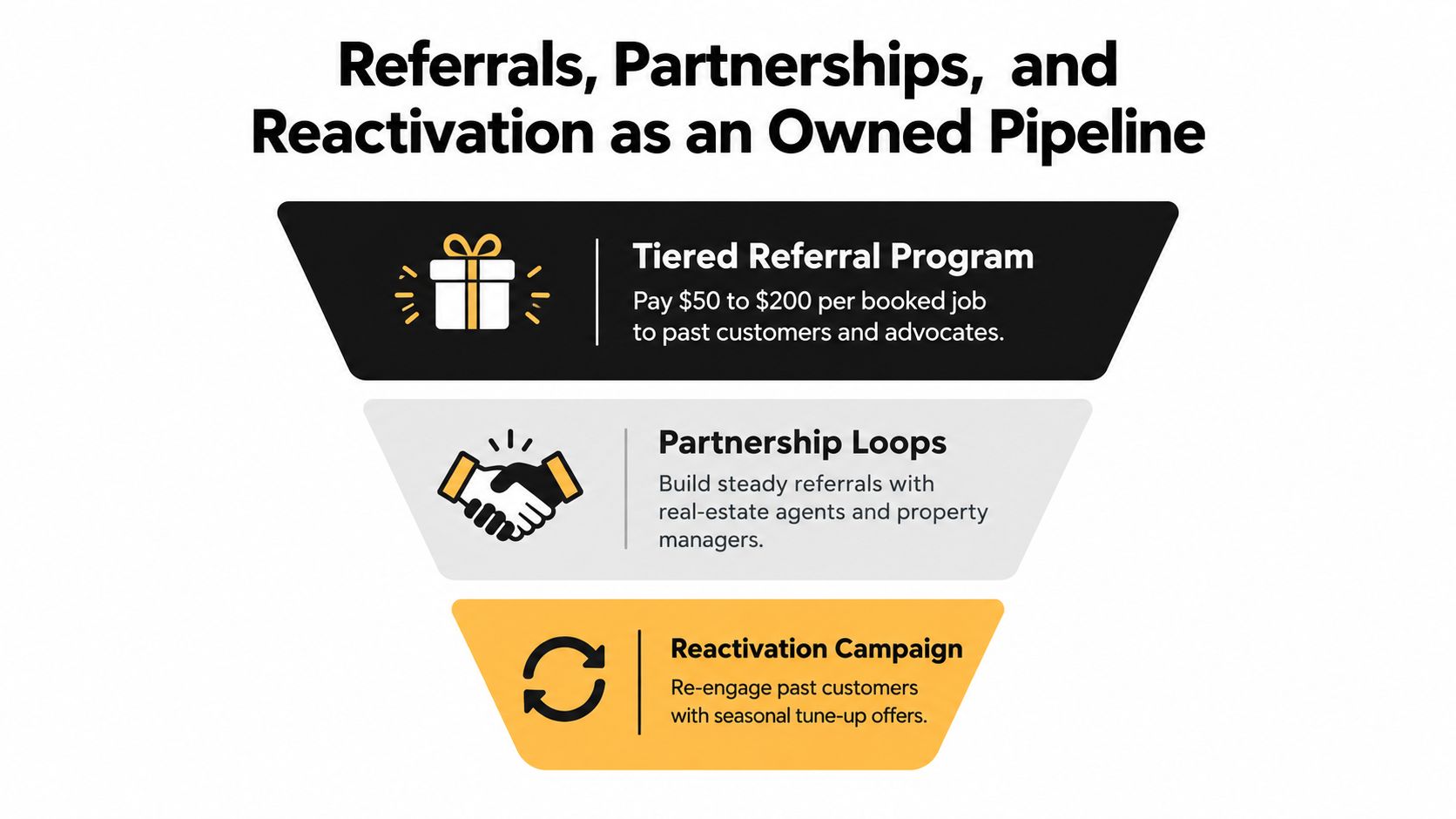
A real referral program needs three things. A clear ask, a simple path, and a reward that doesn't destroy margin.
You can make this work with:
- Past customers who already trust your work
- Real estate agents who need reliable names for buyers and sellers
- Property managers who care about response and documentation
- Neighbors near recent jobs who saw your truck and now know the name
Useful mechanics include a QR-coded refrigerator card, a printed referral card in the closeout packet, and follow-up texts that give the customer an easy way to pass your info along.
The payout structure should match the job type and your margin tolerance. Some shops pay cash equivalents. Others keep it cleaner with account credit. The right move depends on your bookkeeping and whether the referral source is a customer, partner, or business contact.
Partnership loops beat random networking
The strongest trade partnerships usually come from adjacent services, not generic chamber-of-commerce handshakes.
Good fits include:
- HVAC companies that run into drain or gas-line issues
- Electricians who see panel and water heater upgrade opportunities
- Restoration companies handling water damage events
- Home inspectors and agents who need a plumber fast during transactions
A co-branded move-in checklist for agents works because it gives them something useful to hand a homeowner, not just another business card. For property managers, speed and documentation usually matter more than discounting.
If you still lean heavily on local visibility tactics, this guide to offline marketing and local SEO ideas can help tie old-school neighborhood promotion back into your digital pipeline.
Reactivation is usually the easiest win
Slow weeks are often a database problem, not a demand problem.
Recent 2026 guidance highlighted a smarter mix for plumbers: water-heater upgrade campaigns, drain-maintenance memberships, and reactivation of past customers can fill slow periods more predictably than chasing only emergency jobs, as described in this 2026 plumbing lead generation guidance.
That fits what a lot of shops see in the field. Homeowners with aging equipment, unresolved quotes, prior service history, or a recent home purchase often convert better than cold strangers from a shared lead source.
Good reactivation targets include:
- Past water heater customers who may be ready for maintenance, upgrades, or related work
- Quoted but unsold jobs that went quiet
- Customers from slower seasons who need preventive service reminders
- Recent movers who want baseline inspections or fixture updates
Track all of it inside the same CRM with dedicated phone numbers or tagged links so referrals, partner leads, and reactivation don't disappear into "word of mouth."
Owned pipeline is calmer money. You already have the trust. You just need a system to ask, follow up, and track it.
Speed-to-Lead, Reviews, and the Reputation Flywheel
This section is often overlooked in marketing articles because it isn't glamorous. However, it's where a lot of booked jobs are won or lost.
If your shop responds slowly, asks weak questions, or fails to ask for reviews while the homeowner is still happy, your marketing never compounds.
Speed wins emergency plumbing calls
For home-service contractors, responding within 5 minutes makes you 21x more likely to convert a lead than responding in 30 minutes, and conversion probability drops by about 90% after one hour, according to this home-service lead response benchmark.
That should shape your workflow immediately.
| Response Time | Contact Rate | Qualified Rate | Booked Job Rate |
|---|---|---|---|
| Within 5 minutes | Highest | Strongest | Best |
| Around 30 minutes | Lower | Weaker | Noticeably worse |
| After 1 hour | Very low | Poor | Severely reduced |
The exact percentages will vary by market and call quality, but the pattern doesn't.
What the first contact should look like
Most plumbing shops don't need a fancy script. They need a repeatable triage sequence.
Use something close to this:
- Confirm the problem first. Leak, clog, sewer, no hot water, install, quote, or inspection.
- Check urgency next. Is water actively running, backing up, or causing damage right now?
- Confirm location and service area. Don't spend five minutes on a lead you won't service.
- Ask who owns the property. It changes urgency, authority, and scheduling.
- Offer the appointment directly. Don't end with "we'll call you back."
If the call is missed, the text-back window should be immediate. A short message that says you saw the call, can help, and are ready to book keeps the conversation alive while the homeowner is still deciding.
Reviews create the flywheel
Reviews aren't just reputation dressing. They support local trust, ad performance, and close rate because homeowners use them as a shortcut when choosing between similar plumbers.
The workflow should be simple:
- Technician asks in person right after the successful job
- Office sends the review text as soon as the ticket closes
- Invoice includes a QR code
- Google gets priority first, with Yelp considered where that platform matters locally
A smaller profile with tighter recency, better response habits, and more service-specific wording can outperform a larger but stale review profile. That's why review generation should run as a weekly discipline, not a quarterly push.
The best time to ask for a review is when the sink is draining, the water is hot again, and the customer is relieved.
For a one-person shop, a sustainable cadence is enough. Ask after every completed ticket, respond to every new review, and watch for repeated wording that helps future customers trust the next click.
Reputation compounds when speed, call handling, and review requests all happen inside one routine. That's the flywheel. Fast response leads to more booked jobs. More booked jobs create more happy customers. More happy customers create fresher reviews. Fresher reviews help the next lead choose you faster.
Tracking, CRM, and the Offline Tactics That Still Print Jobs
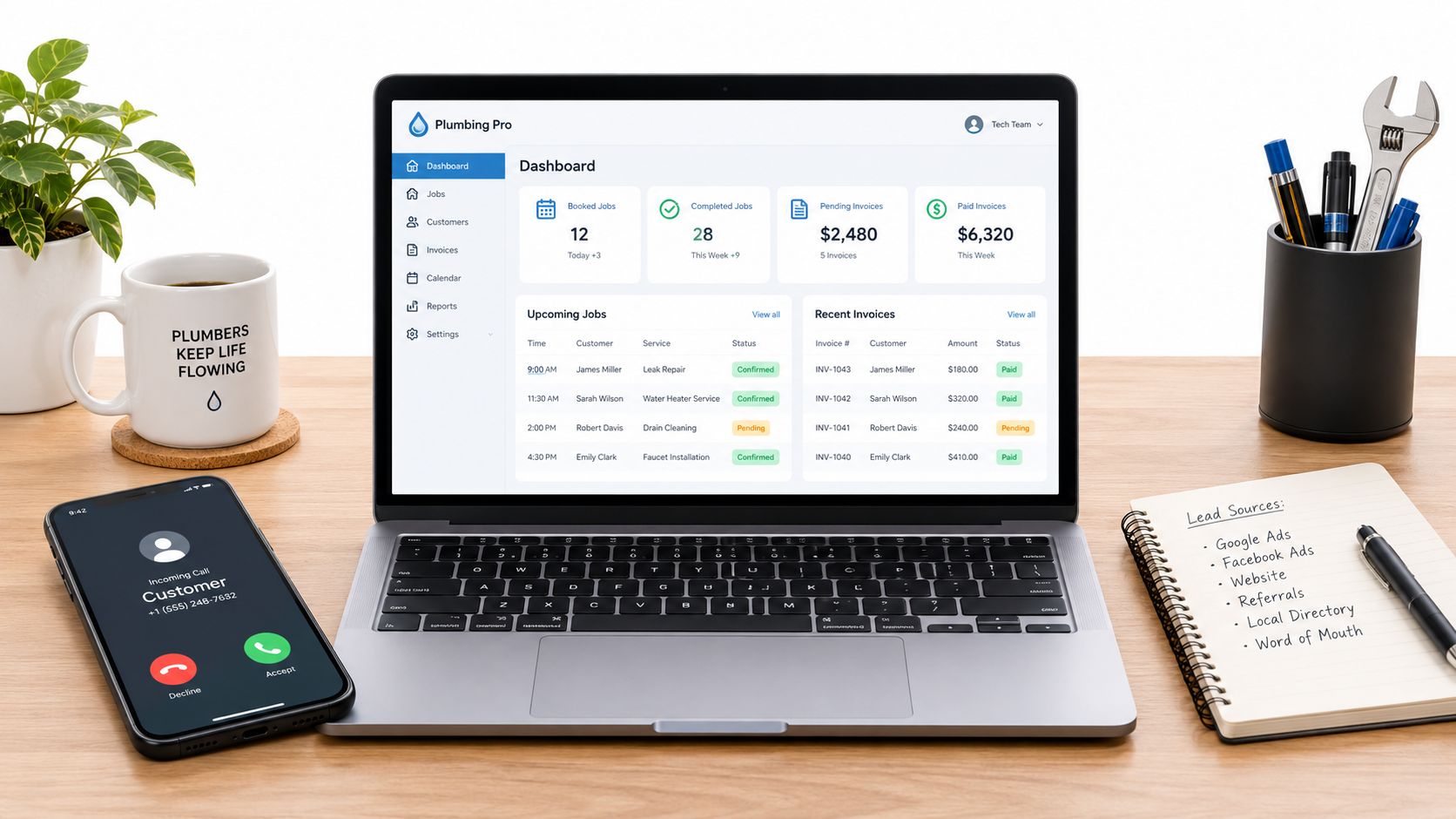
Most plumber lead generation problems get foggy because the owner can't answer a basic question. Which source produced the booked job that got invoiced and collected?
If you can't trace that path, you'll keep making decisions by gut.
Build one tracking spine
Every lead source should feed the same operating system.
At minimum, set up:
- A unique call-tracking number per channel. One for Google Ads, one for Local Services Ads, one for Google Business Profile, one for direct mail, one for truck signage if possible.
- Dynamic number insertion on the website. That lets you see which source drove the call without forcing multiple websites.
- Tagged form submissions. Every form should pass source data into the CRM.
- A visible pipeline. Use stages like New Lead, Qualified, Scheduled, In Progress, Completed, and Collected.
- Outcome notes. Record what job was sold, not just that "a lead came in."
Good plumbers often don't need more software. They need cleaner use of the software they already have. If you're evaluating options, reviewing local SEO and marketing software categories can help you map what belongs in the stack and what doesn't.
Offline still works when it's trackable
A lot of old-school plumbing marketing still prints jobs. The mistake is running it without attribution.
Use offline tactics that feed the same CRM:
- Door hangers after a completed job. Drop them on the surrounding homes while the truck is already there.
- Truck magnets or wraps with a trackable number. Branding is nice. A unique phone number is better.
- Yard signs with a QR code. Send people to a simple landing page for the service tied to that neighborhood.
- Print mailers to past customers. Seasonal reminders, upgrade campaigns, and maintenance offers still work when the audience knows your name.
The trick is simple. Every offline asset should use either a dedicated number, a dedicated URL, or both.
Review the board every week
You don't need a fancy dashboard if no one looks at it. You need a weekly review habit.
Check:
- Answer rate
- Lead source
- Booking status
- Booked job quality
- Collected revenue by source
- No-show and cancellation patterns
A sharp drop in booking rate can hide for weeks if all you watch is call count. But if you review source-to-booking movement weekly, you'll spot intake problems, offer mismatch, or broken follow-up while the fix is still easy.
The offline-to-online loop matters here. The call from a truck magnet and the form fill from a city page should end up in the same truth system. That's how you get honest visibility into what's feeding the shop.
Your 90-Day Plumber Lead Generation Plan
Most plumbing owners don't need another giant marketing strategy doc. They need a plan they can start on Monday without turning the office upside down.
This one works because it starts with leakage, then adds acquisition, then builds owned demand.
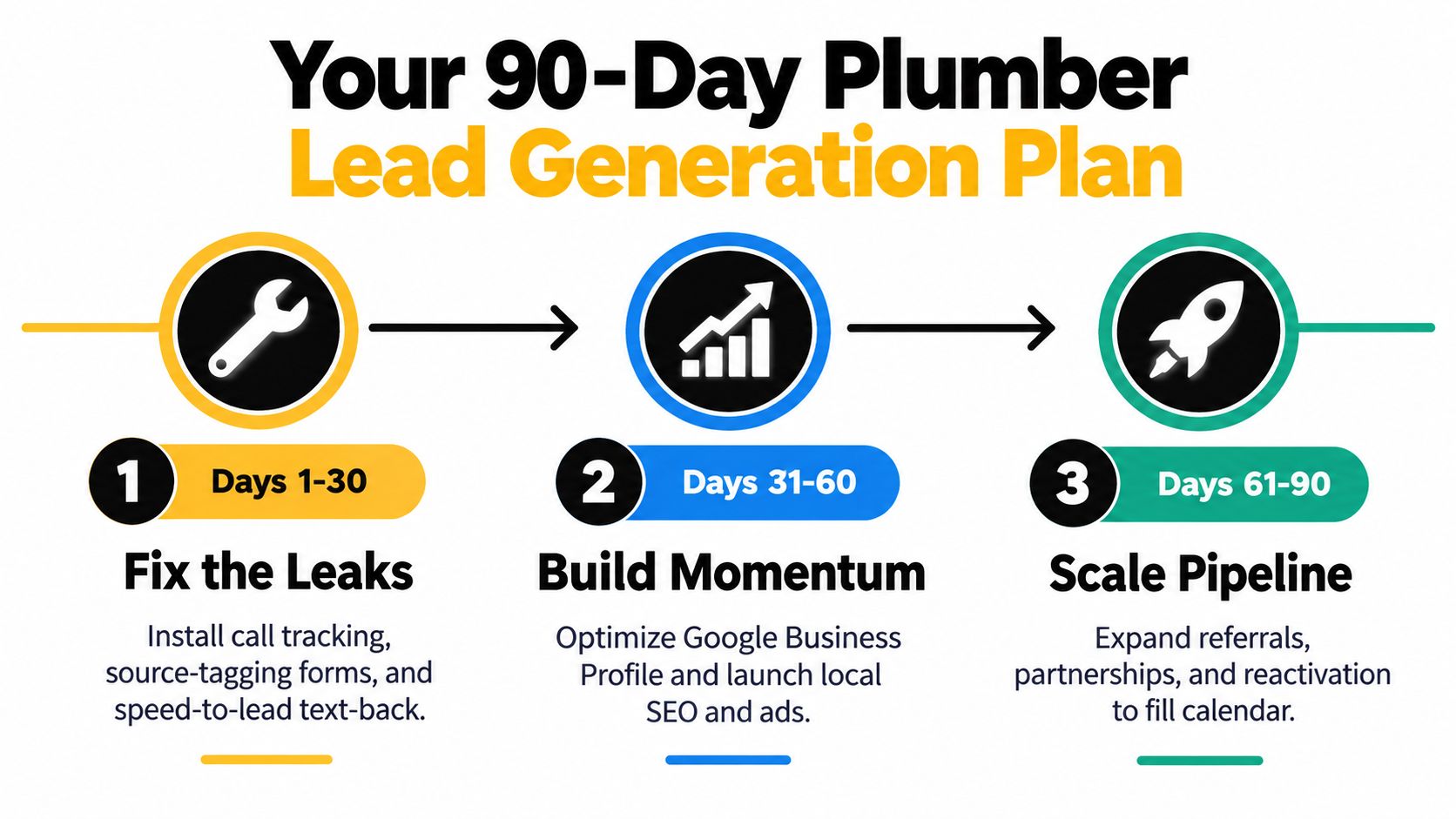
Days 1 to 30 fix the leaks
Your first month is operational.
Install call tracking. Tag every website form by source. Turn on missed-call text-back. Clean up the Google Business Profile with correct services, fresh photos, service areas, and Q&A. Make sure every inbound lead has one owner and one expected next step.
Use a simple missed-call script:
"Sorry we missed your call. This is [Company Name]. If you still need a plumber, reply here with your issue and address, or call back now and we'll get you scheduled."
Also set the basic follow-up cadence:
- Text at 5 minutes if the lead didn't connect
- Call at 30 minutes
- Email at 24 hours for form leads or estimate requests
- Nurture follow-up at 14 days for non-urgent opportunities
Days 31 to 60 build momentum
Once intake is stable, start adding controlled demand.
Launch a tight Google Search campaign around your highest-intent service terms. Add Local Services Ads after the profile and service setup are clean. Ask for reviews after every completed ticket. Send a reactivation message or mail piece to past customers with a relevant seasonal or service-specific offer.
This is also a good window to start a lightweight email follow-up habit if you've ignored your customer list. If you need a practical walkthrough, this guide on how to create an email newsletter can help you set the basics without overcomplicating it.
Days 61 to 90 scale the pipeline you own
Month three is where plumber lead generation starts acting like a system instead of a set of disconnected tactics.
Stand up a referral program with a real reward structure. Build relationships with at least two complementary trades. Publish two plumbing-specific landing pages tied to profitable services or local areas. Route every referral, partner lead, and reactivation contact into the CRM with source tracking.
Your dashboard at this point should show:
- Cost per booked job
- Answer rate
- Lead-to-booking rate
- Booked-job quality by source
- Close rate
- Collected revenue by source
If a source sends leads but not booked work, fix intake or cut it. If a source books well but ticket quality is poor, tighten qualification. If referrals close best, pour more energy into the ask.
The point of the 90-day plan isn't to do everything. It's to build the sequence in the right order. First stop the leaks. Then buy or rank for more demand. Then build the owned pipeline that makes the whole shop less dependent on rented attention.
SEO Specialist and product builder with 10+ years in search. The notes come from the work, not the theory.