8 Best Lead Generation Companies for B2B in 2026
Compare the 8 best lead generation companies of 2026 by published price, minimum commitment and what each package leaves out, so you can shortlist faster.

Nearly every ranking of the best lead generation companies sorts vendors by logo recognition. Your budget gets decided by three other things: the starting price, the minimum commitment, and what the package deliberately leaves out. A $750 appointment and a $11,950 four-week program can produce the same pipeline, and neither number tells you anything until you know the setup fee and the exit terms.
The category is also bigger and messier than most lists admit. One industry compilation counted approximately 310,015 lead-generation companies worldwide, of which only 111 were identified as lead-generation technology providers, according to 99firms' lead generation statistics research. Agencies, data brokers, ad networks and software platforms all get shuffled into one list, then compared on metrics that don't apply to half of them.
So the filter here is narrow. Every entry either publishes a real number or has a scope you can pin down in writing before a discovery call. I opened each vendor's own pricing or service page while putting this list together, and five of the eight put a number on it.
Three pricing models show up:
- Per appointment: you pay for a booked meeting, usually with a setup fee and a starter minimum.
- Monthly retainer: you pay for a team and its activity, whether or not meetings land that month.
- Quote only: no rate card, so the scope document becomes your only price protection.
No vendor can guarantee a lead count or a closed deal. Match the model to your sales motion instead of shopping for a promise.
Read the starting price and the exclusion line for each pick and you can disqualify half of them in under two minutes.
1. Outbound Consulting
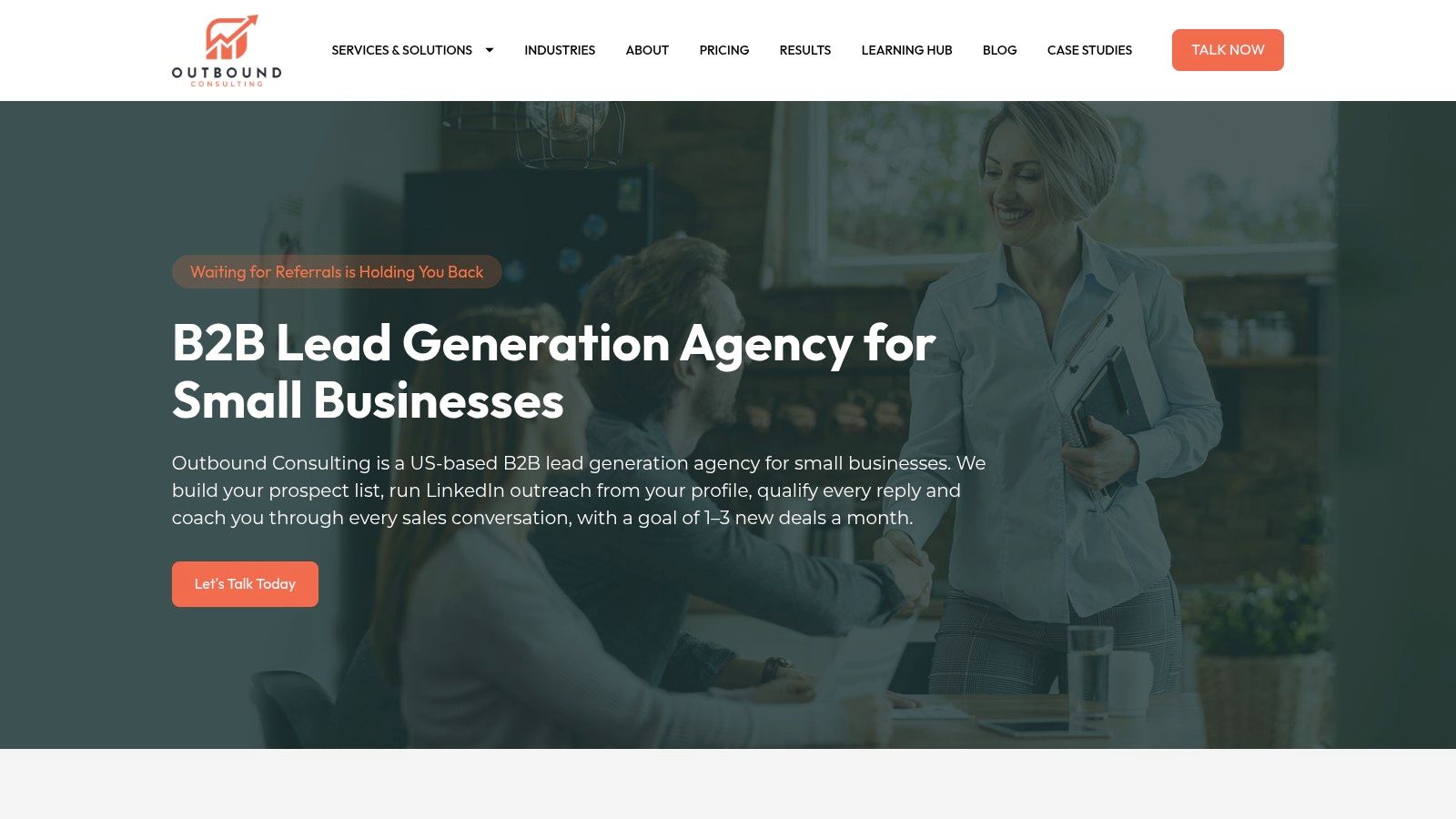
A flat monthly fee with no commissions buys LinkedIn prospecting and sales coaching here. The exclusion matters: Outbound Consulting doesn't book meetings on your behalf. It qualifies every reply, then coaches you through the sales conversation and the proposal.
You still have to sell.
That makes this a better fit for a founder-led consultancy, agency or B2B services firm than a team shopping for a calendar full of appointments. The service supports your own sales process, so budget for the fee and the time someone on your team must spend taking calls and following up.
What the flat monthly fee actually buys
The work combines prospect research, hands-on outreach and coaching:
- Managed LinkedIn outreach: daily connection requests, follow-ups and human-written messages sent from your own profile, in your voice.
- Custom list building: Sales Navigator searches, Boolean targeting, exclusion lists and targeting revisions based on campaign performance.
- Market research first: ideal client profile, market size, LinkedIn reachability and persona selection before outreach starts.
- Sales coaching: a dedicated strategist drafts replies, prepares call talking points and runs weekly strategy calls.
- Profile alignment: your LinkedIn profile and company page are cleaned up so prospects see positioning that matches the messages.
The practical benefit is continuity between targeting, messaging and the call. A positive reply gives the strategist something to help you work with, rather than leaving you to turn interest into a proposal alone.
The campaign goes live about a week after the kickoff call. You own the prospect lists, messaging and connections you build, which gives you something to keep using after the engagement ends.
What it costs, and the minimum commitment
The Outbound Consulting pricing page lists two pilots. Gold is $2,500 a month for four months. Platinum is $2,000 a month for six months and adds two LinkedIn posts a month written in your voice.
The pilot length is the minimum commitment, so the floor is $10,000 on Gold and $12,000 on Platinum. A $200 deposit reserves the kickoff call, and it runs month to month once the pilot ends.
Two more terms to read before you sign. You buy your own LinkedIn Sales Navigator seat, which the page puts at $99 a month. And cancelling needs written notice at least 30 days before the pilot ends.
The page also says the rate drops to $1,250 a month if the pilot ends without a closed deal. Get that line into your agreement rather than relying on the pricing page.
Who should hire it, and who shouldn't
I'd shortlist it for a small services business that relies on referrals and needs a repeatable LinkedIn prospecting process. The coaching is particularly relevant when the founder takes sales calls but needs help with replies, preparation and proposals.
Disqualify it if your buyers require cold email or cold calling. Outreach runs on LinkedIn only. Also pass if nobody on your side has time to handle sales conversations.
The buying decision is whether you need supported prospecting or outsourced appointment booking. This offer fits the former.
2. Belkins
Belkins is the clearest published per-appointment offer on this list, and the arithmetic is public. Its pay-per-appointment package starts at $750 per appointment plus a $1,500 one-time setup fee, with a 10-appointment starter package.
That makes the starter package $9,000, or $900 a meeting once the setup fee is spread across all ten. Your true cost per meeting stays above the headline rate until you do that sum.
The exclusions are printed, which I respect more than a vague "custom scope." The package leaves out cold calling and every channel beyond email and LinkedIn, account research, and CRM or pipeline management. If your buyers only answer the phone, you're buying the wrong package.
What you do get is targeting strategy, campaign messaging, email and LinkedIn outreach, reply handling, booking into your calendar, and monthly reporting. A no-show does not count against your package. Phone outreach sits in Belkins' standard retainer service, which is custom-priced, so the published package is a floor, not a ceiling.
Read the delivery terms too. Belkins delivers the package within six months of launch, and if it falls short the page offers a partial refund for unused appointments. The setup fee is not refundable.
Budget rule: divide the setup fee across the minimum term before you compare a per-appointment price to a monthly retainer. Otherwise you're comparing a sticker to an invoice.
Volume isn't your problem if you're already running campaigns. Cirrus Insight reports that organizations generate an average of 1,877 leads per month, and that 80% of them never convert to customers, in its lead generation statistics roundup. Paying per booked meeting is how you stop paying for names.
Two practical notes. First, your list quality decides the outcome, so tighten targeting before launch using the approach in our guide to the best email finder tools for LinkedIn. Second, Belkins needs fast feedback from you on which meetings were real. Teams that go quiet for two weeks burn their starter package on the wrong persona.
Hire it if you have closers and want outreach off your plate. Skip it if the starter package plus setup would swallow your entire quarterly marketing budget.
3. SalesRoads
Run the monthly comparison before you flinch at the sticker. SalesRoads publishes a base program at $11,950 per four-week period on its pricing page. Thirteen four-week periods make a year, so that is closer to $12,950 a calendar month than $12,000.
It is more than double the $5,000 entry retainer EBQ quotes for a half-time rep, and it buys a different thing: one dedicated SDR on a phone-first program with a full team behind it. A second SDR takes the total to $16,750, which drops the cost per rep to $8,375.
The deliverables are stated, which makes scoping possible without three calls. You get an enriched prospect list, a custom demand-generation playbook, SDRs doing live calling plus email prospecting, a real-time dashboard, work inside your own CRM and ongoing quality checks. Strategy, data work and coaching come bundled rather than billed as add-ons.
Phone-led outbound is a real advantage in some markets and a dead end in others. Owners in trades, logistics, healthcare services and manufacturing often pick up. Software engineers and design leads almost never do. Ask which of your last ten closed deals started with a phone conversation before you sign anything.
The honest trade-offs:
- Commitment size: the page says there is no long-term commitment and you can cancel anytime, but one period at this price is still a serious bet for a small business or an unproven offer.
- No output guarantee: the fee buys a program and its activity, not a promised count of qualified leads or sales.
- Channel risk: if your audience screens calls, you're paying premium rates for voicemail.
I'd recommend SalesRoads to mid-market and enterprise teams with a proven offer, a defined territory and a sales manager who will listen to call recordings. If you're a two-person shop testing a new service, start smaller and come back when you know what converts.
4. SalesHive
SalesHive bundles the whole outsourced SDR function into one monthly number: SDRs, a strategist, the platform, data and outreach tools, with CRM syncing wired in. You can choose phone-only or phone plus email, and pick a daily outreach volume. There are U.S.-based SDR options and offshore options, and the price moves with that choice.
The catch is the one this whole list is built around. The SalesHive pricing page shows how a quote is built but no dollar figure, so you need a 30-minute call to get a number. It lists both month-to-month and annual plans, and those terms are worth reading line by line before you agree to anything.
Two of those terms work in your favour. You owe nothing until you approve the team, playbook and messaging for launch. And a month-to-month plan can be cancelled with written notice, with billing ending at the end of the next billing month.
Bundling is useful when you don't want to buy data, a sequencer and a dialer separately. It also hides the unit economics, which is where small teams get hurt. In recent SMB survey data compiled by Intandem's SMB lead generation statistics report, 25% of surveyed small and midsize businesses didn't track where leads came from and 19% didn't know their acquisition cost. If you're in that group, a bundled retainer is unmeasurable by definition.
Fix the measurement before the vendor call, not after:
- One source field per program: tag every inbound record with the vendor name and campaign, not "outbound."
- A dedicated tracking number: route SalesHive-sourced calls through their own line so attribution survives the phone.
- Weekly opportunity count: meetings booked, opportunities created, deals closed, in one sheet you own.
Local and service businesses have an extra wrinkle, since geography caps how much outbound volume is useful. Our breakdown of plumber lead generation shows how narrow a serviceable territory really gets.
Hire SalesHive if you want one invoice for an SDR function and you already track pipeline. Skip it if you need inbound marketing too, because this is outbound only.
5. Martal Group
Martal Group sits at the wide end of the scope spectrum. Its sales executives coordinate phone, email and LinkedIn, then handle lead research, qualification against criteria you agree on, nurturing and funnel optimization. Tiers run from lead generation and appointment setting up to broader sales outsourcing, including customer onboarding and account management.
Email carries real weight in that mix. Dataintelo valued the global lead-generation solutions market at USD 7.1 billion in 2025, with email marketing holding the largest solution share at 28.4%, in its lead generation solutions market report. Multichannel programs like this one lean on that channel hardest, which means your domain setup and list hygiene matter as much as the vendor's script.
Pricing is quote-based. Martal's pricing page lists three service tiers, and each one ends in a "customize your pricing" button rather than a rate. That's the trade-off you accept for scope flexibility, and it means the statement of work is your only price protection. Get the tier, the channels, the monthly activity and the qualification definition written down.
Two things Martal does that make evaluation easier. Its homepage profiles its onshore reps by name, city and years in B2B sales, so you can see who might run your account before the first call. And its case studies report intermediate metrics such as leads, MQLs, SQLs and meetings, which lets you sanity-check the funnel instead of staring at a revenue claim.
Ask what the quoted tier excludes before you ask what it includes. Onboarding and account management are useful, but they're not prospecting, and you shouldn't pay prospecting rates for them.
The scope breadth cuts both ways. If all you need is contact research and a warm handoff, you're buying more machine than you'll use. Teams running paid social alongside outbound should also read our comparison of the best Facebook ad agencies so the two programs don't chase the same accounts.
Hire Martal if you're a B2B or technology company selling across North America and want qualified meetings plus downstream sales support.
6. memoryBlue
The number that matters at memoryBlue is one you only get on a call. Its site says there is no single published rate, because the price depends on the service, the team size and whether the engagement is outcome-based or a standard retainer.
What it does publish is the ramp. Most programs start with a short non-billable onboarding period, roughly two weeks for an SDR program, where targeting, messaging and playbooks get built before live outreach begins. You are not billed for that build-out, but don't expect meetings in week one either.
memoryBlue's SDR service supplies dedicated SDRs, never split across accounts, managed day to day by a Delivery Manager and working phone, email and LinkedIn. Target lists are built from your ICP, firmographic data and buying signals, and reviews run weekly, monthly and quarterly. The company says you keep full ownership of the accounts, data and strategy, which is the clause to confirm in your own contract.
Its own benchmark is 8 to 12 outbound meetings booked per SDR per month once a program is fully ramped. Treat that as the number to test on the call, not as a promise.
You are buying capacity, not a lead list. Dedicated reps learn your market and stay on it, which suits a long sales cycle better than a one-time list dump. The trade-off is that you pay for continuity whether or not a given month produces meetings. If your qualification rules are vague, that continuity just gives the team more time to prospect against a weak target profile.
One option here is rare. memoryBlue lets you convert a rep to your own payroll, which most outsourced SDR contracts make difficult.
The market you are buying into is expanding fast. Emergen Research valued the global B2B lead-generation market at USD 11.12 billion in 2025 in its B2B lead generation market report. A supplier ecosystem that size produces plenty of vendors with similar-sounding pitches. Separate them on scope documents, not adjectives.
With no public price, you need a full quote. Before you take the call, have three things ready:
- A written ICP: industry, headcount band, geography, job titles, and the disqualifiers you will refuse to pay for.
- Your current stage definitions: what counts as a qualified meeting, in your CRM's words, not the vendor's.
- A named follow-up owner: someone who replies to booked conversations the same day.
I would recommend memoryBlue to technology and B2B services firms with a defined target profile and an existing sales process. If you are still guessing who buys, a dedicated rep will spend your retainer finding that out for you, slowly. And if your nurture runs on email, our roundup of the best email marketing tools for small business covers the cheap half of that job.
7. EBQ
EBQ states a starting retainer of $5,000 per month, and the fine print is the reason to look twice. On EBQ's pricing page that figure buys a half-time specialist and reflects an annual commitment. A full-time rep is $10,000 a month on the same terms.
The included staffing is the stronger part of the offer. Every plan comes with a business consultant, a project manager, a weekly management meeting and EBQ's tool suite at no extra cost. Its appointment setting page calls this a built-in management layer, with a fractional Revenue Consultant and a Business Development Manager training the rep.
That management layer is what separates this from a body-shop SDR seat. Teams without internal SDR oversight usually need that more than they need a second dialer.
Now the funnel math, because a retainer only makes sense against opportunity yield. Published benchmarks at Lead Spot put progression from marketing-qualified lead to sales-qualified or sales-accepted lead at about 13%, and roughly 47% of those SQLs or SALs converting into opportunities. Cheap leads that stall at the first gate cost more per opportunity than expensive leads that clear both.
Practical rule: price every retainer as cost per opportunity, not cost per lead. Ask the vendor to report both gates monthly, using your definitions.
Actual scope and cost move with industry, lead volume and qualification strictness, so $5,000 is a floor. And you still need your own sales staff to run meetings and close, which is the exclusion buyers forget.
Hire EBQ if you want an embedded rep who works inside your sales workflow and you have nobody to manage SDRs internally. Skip it if you're pre-revenue or testing an offer, because $60,000 across an annual commitment is a heavy way to learn that your positioning is wrong.
8. Cleverly
Cleverly is on this list for one service: done-for-you LinkedIn lead generation. That means prospect targeting plus personalized outreach to start conversations with B2B decision-makers, with replies and campaign numbers tracked in a dashboard. It also sells cold email, cold calling and a white-label version for agencies that want to resell the service.
The LinkedIn service is the one with a published price. Cleverly's FAQ puts those plans at $397 to $997 a month, depending on campaign needs, with discounts for team plans of three or more users. Cold email runs on a separate pay-per-meeting-ready-lead model, month to month with no contract.
I could not find a plan table on the homepage when I last checked, so get the current figure in writing before you compare it with a phone-led program. Ask specifically about message approval, account access, daily activity limits and who owns the connection history if you leave.
That last question matters more than the monthly number. If the connections live in an account the vendor controls, your pipeline walks out the door with the contract.
The channel bet is the whole decision. Lead generation sits at the top of B2B marketing priority lists year after year, and much of that pressure lands on LinkedIn because everyone's buyers are supposedly there. Yours might not be.
Pull your last ten closed deals and check where the first conversation happened. If the answer is phone calls, referrals or trade shows, a LinkedIn-only program is a mismatch no amount of good copy fixes.
Where Cleverly fits well:
- Consultants, agencies and SaaS founders whose buyers already answer LinkedIn messages.
- Marketing agencies that want a white-label prospecting arm without hiring SDRs.
- Teams testing outbound at lower cost before committing to a phone-led retainer.
Where it doesn't: field services, industrial buyers, and any market where the decision-maker rarely logs in. One more trade-off: because outreach runs through LinkedIn, your volume ceiling is set by the platform's activity limits, not by how much you pay. Scaling means more accounts or more time, not a bigger budget.
Vendor outcome claims don't substitute for checking audience fit and contract terms. Hire Cleverly if your buyers live on LinkedIn and you want conversations started without building an outreach team. Skip the LinkedIn plan if you need multichannel coverage or guaranteed meeting volume, because neither is what it sells.
The 8 lead generation companies compared on price, channels and fit
| Company | Published pricing | Outreach channels | Best for | Main limitation |
|---|---|---|---|---|
| Outbound Consulting | $2,000 to $2,500 a month; four or six month pilot, $200 deposit | Small and midsize businesses needing prospecting and sales coaching | Does not book meetings; clients take sales calls | |
| Belkins | From $750 per appointment, plus $1,500 setup; 10-appointment minimum | Email, LinkedIn (phone on retainer plans) | B2B teams seeking managed outreach and appointment setting | Setup fee is not refundable; no cold calling in the package |
| SalesRoads | From $11,950 per four-week period | Phone, email | Mid-market and enterprise teams seeking phone-led outbound | High starting cost; no guaranteed lead volume |
| SalesHive | Custom monthly quotes | Phone, email | B2B companies seeking a bundled outsourced SDR function | Pricing is not itemized publicly |
| Martal Group | Custom quote | Email, LinkedIn, phone | B2B and technology companies seeking outsourced prospecting | No standard public pricing |
| memoryBlue | Custom quote | Phone, email, LinkedIn | Technology and B2B services firms needing dedicated SDR capacity | Requires a clear target customer profile and sales process |
| EBQ | From $5,000 a month for a half-time rep, on an annual commitment | Prospecting and nurturing; channels depend on scope | Organizations seeking an outsourced rep integrated with sales operations | Annual commitment; the entry price buys half a rep |
| Cleverly | $397 to $997 a month for LinkedIn lead generation, per its FAQ | LinkedIn (cold email and calling sold separately) | B2B businesses and agencies seeking managed LinkedIn prospecting | LinkedIn-focused outreach may not fit every audience |
Read the pricing column as a filter, not a menu. Five of the eight publish a number you can budget against before a call:
- Outbound Consulting: $2,000 to $2,500 a month on a four or six month pilot.
- Belkins: $750 per appointment, a $1,500 setup fee and a 10-appointment minimum.
- SalesRoads: $11,950 per four-week period.
- EBQ: $5,000 a month for a half-time rep on an annual commitment.
- Cleverly: $397 to $997 a month for LinkedIn outreach.
The other three want a discovery call before they talk money, which means you spend an hour on a sales process just to learn whether they fit your budget.
A low sticker and a high one are rarely the same product. Belkins charges per booked meeting. SalesRoads charges for the program itself, with reps working your list whether or not the pipeline fills. One model prices the outcome, the other prices the capacity.
The minimum commitment changes the order again. On published terms, the least you can sign for works out to roughly $9,000 at Belkins, $10,000 at Outbound Consulting, $11,950 at SalesRoads and $60,000 at EBQ.
The channels column carries a second filter. Three entries lean heavily or entirely on LinkedIn and email, while SalesRoads and memoryBlue are phone-led and EBQ scopes channels to the engagement. Match that to where your buyers respond before you compare prices.
Pay attention to what each package leaves out. Outbound Consulting prospects and coaches but does not book meetings, so your own closers take every call. memoryBlue needs you to arrive with a clear target customer profile and a working sales process, which early-stage teams often lack. A vendor whose published limitation matches your weakness is the wrong hire at any price.
My recommendation: shortlist two entries whose pricing models differ, get both quotes in writing, and compare them on total cost across the minimum commitment. That single number eliminates half the confusion in this market.
How to Vet a Lead Gen Partner Before You Pay a Setup Fee
You can run this in one call. Ask four questions and write the answers down.
- Minimum commitment and setup fee, in writing: month-to-month, four-week cycles, or annual, and what it costs to leave early.
- What the quoted package excludes: cold calling, deep account research, CRM management and no-show recovery are the usual omissions.
- Which channels the reps use: "multichannel" often means email plus LinkedIn, with phone priced separately.
- What you must supply: ICP, offer positioning, feedback turnaround, and a named person to take the calls.
Transparency is the risk, not price. A 2025 industry survey of more than 600 lead buyers and sellers across 22 industries identified lack of transparency and trust in lead partnerships as the leading operational challenge for buyers, ahead of channel prioritization and a scattered marketing tech stack, according to PX's State of the Industry 2025 report. Ask for consent records, duplicate rates, invalid-lead replacement terms and geographic restrictions before you ask for a case study.
Then collapse all three pricing models into one comparable number: total cost across the minimum term, including setup, divided by meetings you'd realistically hold. A per-appointment package with a setup fee and a starter minimum, a four-week program fee, and a monthly retainer all become the same unit. Spread setup across the minimum term, never across a year you haven't committed to.
Take the small paid pilot when your offer is unproven. A published starter package or a month-to-month retainer teaches you more about your targeting than an annual contract does, and the supplier ecosystem is only getting more crowded. Research and Markets projects the global lead-generation market will grow from approximately $5.59 billion in 2025 to $32.1 billion by 2035, a 17.2% compound annual growth rate, in its global lead generation market forecast.
Last thing, and it's the one buyers argue with most. Your own follow-up speed is usually the bottleneck, not lead volume. If replies sit for two days, no vendor on this page can save the program.
Rented pipeline stops the month you stop paying for it. If you want inbound to carry part of the load, work out your current cost per opportunity first, then compare it with what content and search would need to earn the same meetings. For that groundwork, TheGuideX publishes free guides on SEO, content planning and marketing tools.
SEO Specialist and product builder with 10+ years in search. The notes come from the work, not the theory.